

Sunday Mourning: Special Edition
Eleven to Kill the Ten
Dissection’s last album, the theology stitched into it, and a borrowed goddess who was never asked.
This is a bonus. Nobody asked for it. It is the first Sunday Mourning: Special Edition, an extra LP review offered as thanks to everyone who has started following this place lately, and as an excuse to write about some very dark music that I love. It warms the heart. Very little else does.
The record is Reinkaos, Dissection’s third and last album, released on 30 April 2006. In Sweden that is Walpurgis Eve, Valborgsmässoafton, when people light bonfires to see off the winter. Dissection used it to see off Dissection. Within four months the band had split and the man who wrote it was dead.
Three things, then. A review, because it is an album. A plain account of what Jon Nödtveidt did in 1997, because there is no honest way around it. And the part I care about: reading the lyrics as theology. Black metal has been written about until the words wore smooth, but almost nobody asks what this record thinks the universe is, where it got the idea, and what it took from Hindu tradition without asking.
The record
Eleven tracks, about forty-three minutes, released on the band’s own Black Horizon Music, with The End Records handling North America. Nödtveidt sang and played lead guitar. Set Teitan played guitar and sang backing vocals, and Tomas Asklund played drums. Brice Leclercq is credited as a guest on bass. Erik Danielsson of Watain and Whiplasher of Deathstars added backing vocals, and a singer credited as Nyx 218 duets on the closing Maha Kali. The album was recorded at Black Syndicate Studios in Stockholm and produced by the band with Nightmare Industries, the name Jon’s brother Emil uses in Deathstars. The booklet credits the lyrics to Frater Nemidial, and the release notes say the songs were written by Nödtveidt and Frater Nemidial, with “esoteric expressions” taken from a book called Liber Azerate. Remember that name. It is the key to the whole thing.
The sound is what made people angry. The Somberlain (1993) and Storm of the Light’s Bane (1995) are cold, fast and melodic, twin guitars running off into the snow. Reinkaos is mid-paced, clean and built on riffs that swing. Nexion 218 promises the old storm and Beyond the Horizon arrives at a walk. Starless Aeon and God of Forbidden Light sound nearer mid-nineties In Flames than old Dissection. Xeper-i-Set is the one fast song, and it is gone in three minutes.
Reviewers in 2006 were not kind. Blabbermouth gave it 3 out of 10 in a review that spent its first half on the murder and the second half calling the music “dull, dated sounding Swede-metal castoffs.” Chronicles of Chaos gave it 6 out of 10. Eduardo Rivadavia at AllMusic heard a band frozen in the mid-nineties and called its “only glaring weakness” being “so inherently dated.” Five years later, Chris Dick at Decibel defended it in the magazine’s “Justify Your Shitty Taste” column. He conceded it was “largely panned by critics and booed by fans,” and then said the thing out loud: “Reinkaos is a hard rock album.”
He is right, and it is not an insult. Nödtveidt wrote most of these songs in prison, cut off from a decade of metal, and what came out was the music under the old music: Maiden harmony, heavy metal swagger, the Gothenburg melodic habit he helped invent. Black Dragon is the best thing here, a riff with real swing and a vocal that clips each syllable into the beat like a man counting off a ritual, which is what it is. Dark Mother Divine has the best bridge. Internal Fire is filler.
The common view, that this is the weakest of the three albums, is correct. What it lacks is not speed. It lacks the feeling on Storm that the melodies are wider than the songs holding them. Reinkaos is tidy; every song resolves. For an album whose stated purpose is the dissolution of the cosmos, it is extremely well organised. But it is better than its reputation, and it improves once you know what it is for. It is not trying to be Storm. It is trying to be a liturgy, and hymns are supposed to be catchy.
The man who wrote it
Jon Nödtveidt, born in 1975, formed Dissection in Strömstad in 1989 and wrote nearly everything it recorded. From 1993 the band shared a Gothenburg rehearsal room with At the Gates, and in 1996 toured America with them and Morbid Angel. Daniel Ekeroth’s Swedish Death Metal credits the band with “their own melancholic and atmospheric death metal style,” and At the Gates’ Tomas Lindberg counts them in the Gothenburg scene. On the black metal side, AllMusic calls Storm “a landmark in the melodic black/death metal genre,” and Decibel’s list of “Dissection clones” is headed by Thulcandra, a German band whose catalogue is one long reply to the first two albums. Two subgenres would sound different without him.
In the summer of 1995 he joined a small Satanic group in Gothenburg called the Misanthropic Luciferian Order, the MLO. Its leading figure was a young man known as Vlad, who wrote as Frater Nemidial.
Keillers Park
In the early hours of 22 July 1997, after a night of drinking and amphetamine, Nödtveidt and Vlad met Josef Ben Meddour near a Gothenburg park known as a meeting place for gay men. He was Algerian, had lived in Sweden about ten years, and was 36 by the police count (37 in most newspapers; some spell the name Meddaour). In the account later published by the lead investigator, Lars Ohlin, Ben Meddour asked them about Satanism; they realised he was gay, and it enraged them. They took him to Keillers Park on Ramberget, stopping at Nödtveidt’s flat for a pistol and a stun gun. The stun gun failed. He ran, and was shot in the back and then in the head. He was found the next afternoon at the foot of the old water tower.
In December, Vlad’s girlfriend reported him for abuse and told police he had confessed to the killing. Both men were arrested. Nödtveidt confessed and said Vlad fired both shots; Vlad confessed and said Nödtveidt did. On 6 July 1998 the Gothenburg District Court convicted Vlad of murder and gave him ten years. It convicted Nödtveidt of being an accessory to murder, plus an illegal weapons charge, and gave him eight. In September the appeals court raised Nödtveidt’s sentence to ten years. Both men were released in 2004.
The motive was never settled in court. Ohlin wrote that Nödtveidt called the killing “a sacrifice to Satan” in an early interrogation and later took it back. The police registered it as a hate crime, and Ohlin judged that homophobia was a major factor. Aftonbladet put it more bluntly in 2006: Ben Meddour was killed because of his sexual orientation. The scholar of religion Paul Linjamaa notes that both men told investigators they felt disgust at Ben Meddour’s sexuality, and he concludes that how much the killing came from the group’s beliefs and how much from plain homophobia “is hard to determine.” That is where the evidence leaves it. Asked by Expressen in 2004 whether he was a racist, Nödtveidt said he “really” was not. He declined to discuss the killing, out of respect, he said, for the victim’s family, and said only that he was “not proud of it.” Nobody asked him about homophobia, and he did not volunteer an answer.
Ben Meddour’s body was taken home to Algeria and buried in Algiers. His name is in this review because it ought to be in every review of this album, and it usually is not.
What he said he believed
Nödtveidt was not shy about his theology. In a 2003 interview with Metal Centre, written from prison, he described himself as an “anti-cosmic Satanist” who believed “in the total extinction of cosmic order, the Day of Wrath (The Great Dissolution, Mahapralaya, Ragnarök).” Note the Sanskrit word sitting between the Latin and the Norse. He also said the doctrine “is not for the apathetic masses. It is for the secret elite.” To Expressen in 2004 he said that Satan represented, for him, the ultimate goodness and freedom, and that the creator of this world was the ultimate evil. When he announced the split in May 2006, he said he had “reached the limitations of music as a tool for expressing what I want to express,” and that Reinkaos was “a truly Satanic record blessed by the dark gods.”
In August 2006 he shot himself in his flat in Hässelby, outside Stockholm. The band dated the death to 13 August; Swedish papers reported he was found on the evening of the 16th, in a ring of candles with a book open in front of him. Early reports said The Satanic Bible; Set Teitan said it was a grimoire, and that Nödtveidt despised LaVey. He had told the fanzine Slayer in 2003 that a Satanist “chooses death before dishonor” and that suicide from misery was “un-Satanic.” The scholar Massimo Introvigne reads the death as a planned ritual. That is a reading. The candles, the book and the gun are the record.
Eleven to kill the ten
The MLO calls its doctrine Chaos-Gnosticism, and it turns the ancient Gnostic myth upside down. In the old systems the material world is the work of an ignorant lesser creator, the demiurge, whose rulers, the archons, keep the divine spark trapped in matter until it climbs back to the fullness of light. The MLO keeps the prison and the jailer and moves the exit. Before the cosmos there was not light but Chaos, formless and acausal. The cosmos is a fence built around it. The goal is not to escape upward but to tear the fence down. Linjamaa and Johnny Olsson, writing in the journal Nova Religio in 2023, show how carefully the group borrowed from the modern academic idea of “Gnosticism” to make this look ancient.
Xeper-i-Set asks for the strength to “crush the archon’s cosmic lie.” Starless Aeon promises acausal flames “erasing all signs of the demiurge’s crime.” The key image is in Beyond the Horizon: “Eleven to Kill the Ten.” In Kabbalah the divine life is arranged as ten sefirot, the emanations of the Tree of Life. Medieval Kabbalists also described a “left side,” the sitra ahra, the husks or shells called qliphoth, which belong to the realm of evil. The MLO makes the qliphoth eleven, a number beyond the ten, and treats them as a counter-tree waiting to break through. Liber Azerate names the principle behind them Azerate and gives it the number 218, which is why the opening track is called Nexion 218 and why the singer on Maha Kali is called Nyx 218. The Starless Aeon lyric names Daath, the hidden sefirah, and “Kliffotic forces from beyond” that “will usurp the tree of cosmic lies.”
The reading is real, even where it is bent. Black Dragon opens with a string of dragon names, Tohu and Tehom from the second verse of Genesis, Theli from the Sefer Yetzirah, Leviathan, and Tanin’iver, the “blind dragon” from a thirteenth-century Castilian Kabbalistic text, the Treatise on the Left Emanation, where it is the go-between of Samael and Lilith. Dark Mother Divine calls Lilith Ishet Zenunim, “woman of whoredom,” a title from the Zohar. Nexion 218 is a single line, “Zazas Zazas Nasatanada Zazas,” which Aleister Crowley recorded in The Vision and the Voice as an old formula for opening the Abyss. Starless Aeon has a chorus from the medieval Latin hymn Dies irae, with one edit. The hymn says the world, the saeclum, will dissolve into ash. The lyric replaces it with “cosmos.” The whole program is in that one word.
Not every borrowing survives contact with its source. Xeper-i-Set calls on Set and Apep together as partners against “Ra’s creation.” In Egyptian religion Set is a strange, violent god, but one of his set jobs is standing at the prow of the sun boat and spearing Apep, the serpent of chaos, every night so that the sun can rise again. The Egyptologist Herman te Velde gave the scene a chapter. The album hires the guard and the burglar for the same job. The word Xeper, the Egyptian ḫpr, “to come into being,” entered modern occultism through Michael Aquino’s Temple of Set, founded in 1975.
One more borrowing, which I will handle carefully. Nexion and acausal are load-bearing words in the British Order of Nine Angles, and Linjamaa’s entry on the MLO for the World Religions and Spirituality Project lists that order among the MLO’s sources. We will come back to it.
The borrowed goddess
The closer, Maha Kali, is six minutes of a man singing to the Hindu goddess Kālī while a woman answers as her. It is the album’s most serious borrowing, and better read than you would expect.
Kālī is first clearly told as a story in the Devī Māhātmya, a Sanskrit text of around the sixth century included in the Mārkaṇḍeya Purāṇa. In its seventh chapter she bursts from the forehead of the warrior goddess, black with anger, to destroy the demons Caṇḍa and Muṇḍa. In the eighth she drinks the blood of Raktabīja, a demon who multiplies wherever his blood falls. Her name, the feminine of kāla, means “the black one” and also links her to time, which devours everything. The song’s “Kalika, Black Tongue of Fire” is not decoration. In the Muṇḍaka Upaniṣad (1.2.4), Kālī is the first of the seven flickering tongues of the sacrificial fire. Someone did the reading.
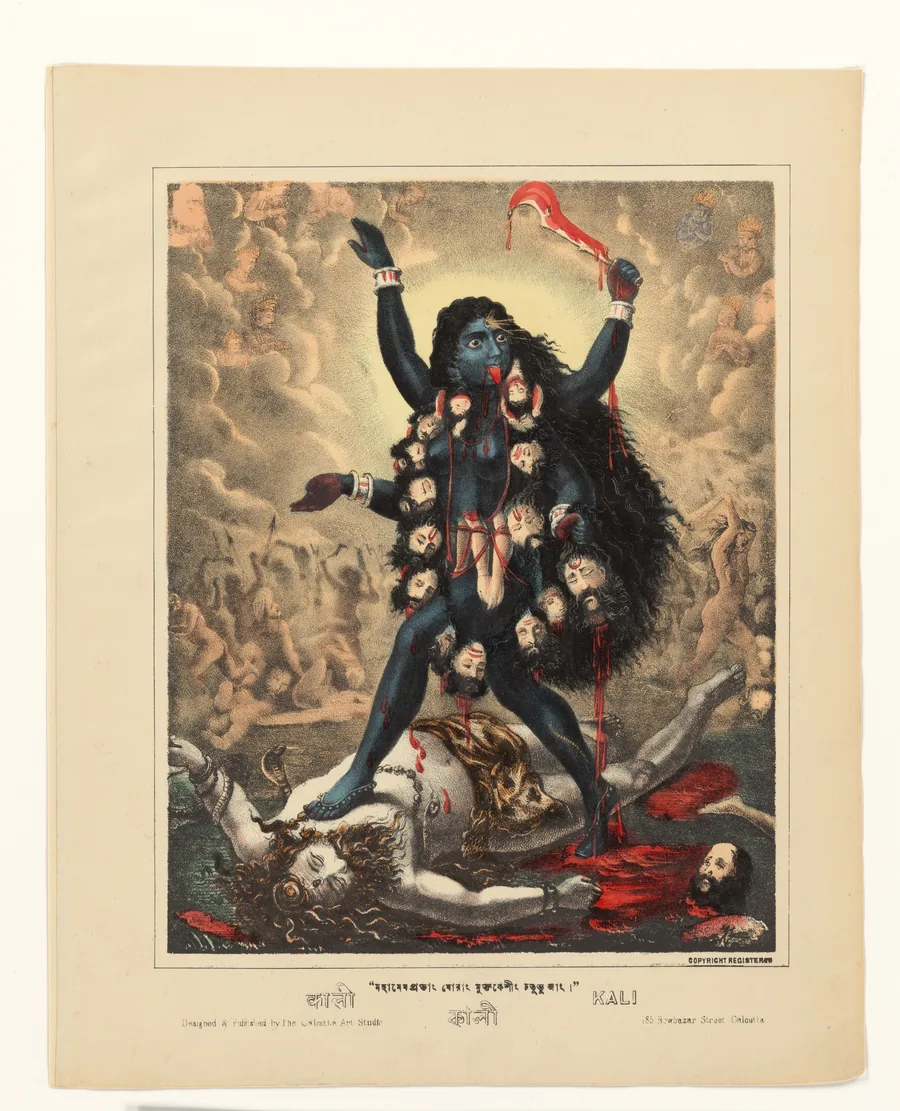
Smashana Kali is Kālī of the cremation ground. The song also quotes, in translation, the eighteenth-century Bengali poet Rāmprasād Sen, who sings that because Kālī loves the burning ground, he has made his heart into one so she can dance there. Rāmprasād’s Kālī is terrifying and also his mother; he scolds her and begs her like a child. In that devotional line, which runs on through Ramakrishna, making your heart a cremation ground means burning off ego and fear until only the goddess is left. It is a love song. On Reinkaos it sits next to “I shall cremate this world and set my essence free.”
The tantric material is used the same way. “At your left hand” points to vāmācāra, the “left-hand practice” of some tantric lineages, which broke purity rules on purpose. The Theosophists, Helena Blavatsky first, made it English shorthand for black magic in the 1880s; later occultists wore it as a badge, and Kennet Granholm’s study of the Stockholm order Dragon Rouge shows how central the label became to Swedish esotericism. In Internal Fire, “The serpent power is rising up my spine” is kundalini, and The Serpent Power is the title of Sir John Woodroffe’s 1919 book, the main route by which Westerners learned about tantra. The line “I cut my own throat in ‘obscene’ ecstasy” calls up Chinnamastā, the self-beheaded goddess among the ten Mahāvidyās, whom David Kinsley describes as an image of life, sex and death feeding each other. “Virgin, mother, whore and crone” is not Hindu at all. It is the neo-pagan Triple Goddess descended from Robert Graves, with one title added.
So the vocabulary is accurate, and the theology is backwards. In Śākta tradition, where the goddess is the highest reality, there is no demiurge. The world is not a prison built by an inferior god. It is the Goddess’s own power and play, which hide her and show her at once. Kālī destroys the world, and she is also the one who makes and keeps it. When Mahāpralaya, the great dissolution, comes in Purāṇic cosmology at the end of a cosmic lifetime, it is followed by a new creation, the way a night is followed by a morning. Nothing in that system needs breaking out of, because the jailer and the prisoner turn out to be the same goddess. Reinkaos takes her sword and leaves her arms behind. It takes the ending and drops the next beginning. It takes Kālī’s fierce form and fits it to a Gnostic dualism she was never part of.
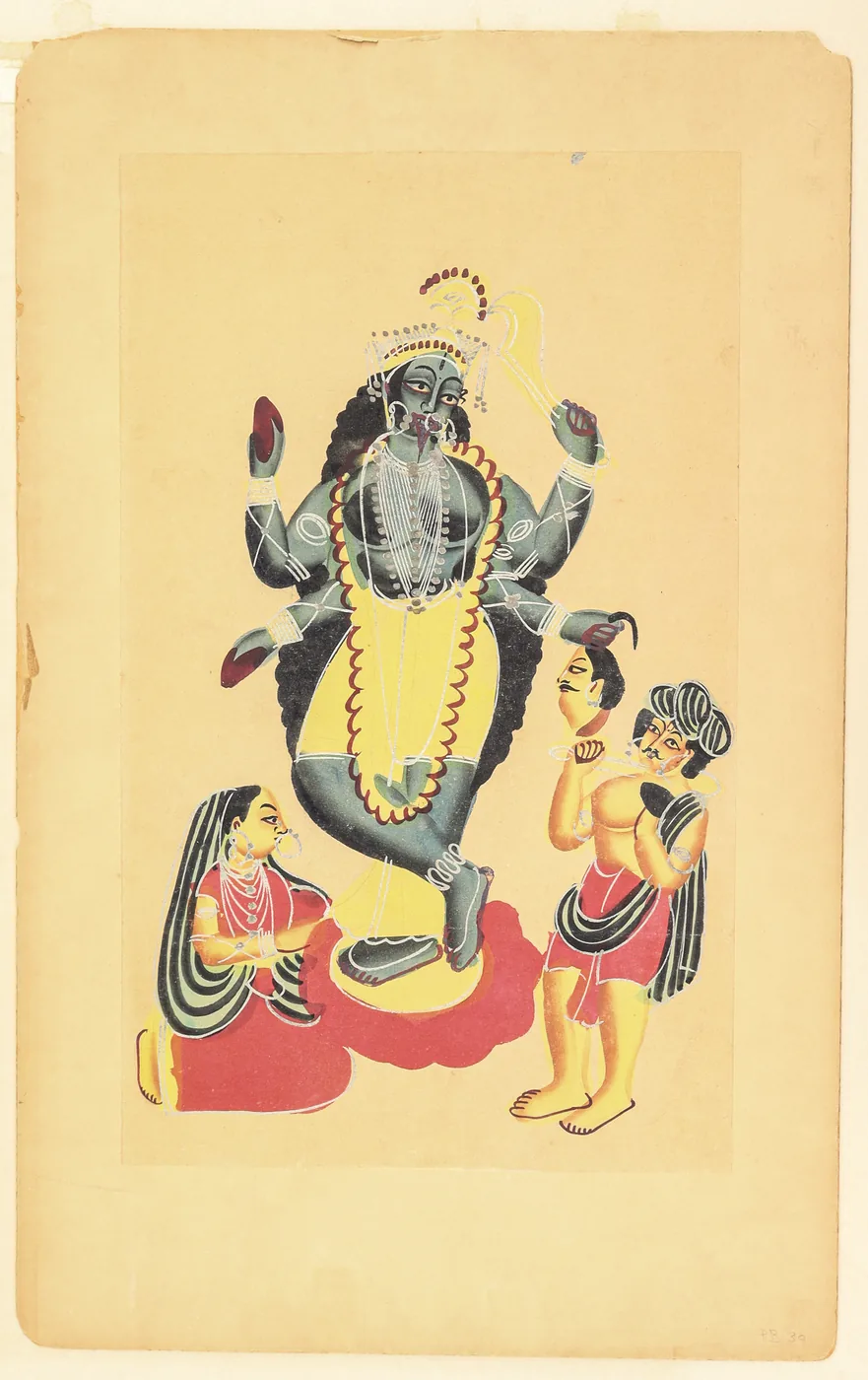
Reinkaos is more learned than Indiana Jones and the Temple of Doom, and makes the same old Western choice: the Kālī who dances on corpses, not the one in the Bengali songs, raising a hand that means “do not be afraid.”
The wheel, and the people who wanted to turn it
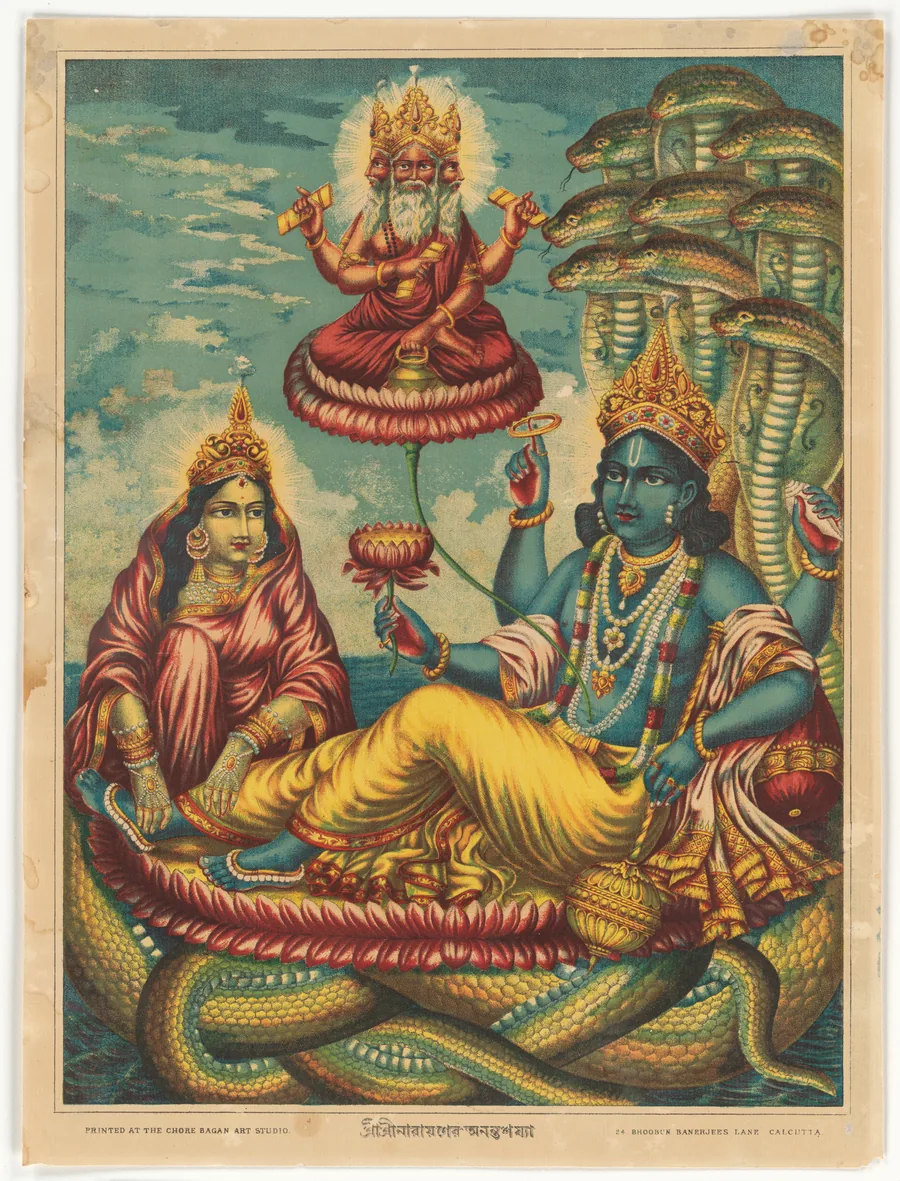
One more Hindu idea runs under this album, and under a much nastier stretch of the twentieth century: cyclical time. In Purāṇic cosmology the ages turn in four declining steps. The last is the Kali Yuga, the age of quarrel, which by tradition began in 3102 BCE. Western writers miss this constantly: the kali in Kali Yuga is not the goddess. It is a different word, short vowel, named for the losing throw at dice. Kālī and the kali age share an English spelling and nothing else. At the end of the age, according to the Viṣṇu Purāṇa and the Bhāgavata Purāṇa, Viṣṇu comes as Kalki, puts an end to the corruption, and the wheel turns back to an age of truth.
Twentieth-century Western esotericists turned that wheel into politics. René Guénon taught that the modern West was living through the Kali Yuga. Julius Evola, the Italian Traditionalist who published a doctrine of “spiritual racism” in 1941, built Revolt Against the Modern World (1934) on that decline, and in The Yoga of Power sold tantra as the discipline fit for a dark age; Hugh Urban has traced where that reading of tantra went on the European far right. Savitri Devi, born Maximiani Portas in Lyon in 1905, moved to India, married a Brahmin, and in The Lightning and the Sun (1958) made Hitler a “man against time,” an avatar of Viṣṇu sent against the Kali Yuga. The same book admires history’s great exterminators as “human likenesses of great Mahakala,” the black, time-eating form of Śiva. Nicholas Goodrick-Clarke’s Hitler’s Priestess and Black Sun are the standard histories.
That movement also stole the swastika, a Sanskrit sign of well-being, and the word “Aryan,” a term for an ancient language family. Even in 1888 the Sanskrit scholar Max Müller warned that someone who spoke of “Aryan race, Aryan blood, Aryan eyes and hair” was making as big an error as a linguist who spoke of “a dolichocephalic dictionary.” No one listened.
Now the careful part. I have found no credible source showing that Nödtveidt, Frater Nemidial or Reinkaos drew on Savitri Devi or Evola, and I am not claiming it. What is documented is an indirect line. David Myatt, the British neo-Nazi whom Goodrick-Clarke identifies with the Order of Nine Angles, was introduced to The Lightning and the Sun and was heavily influenced by it. The Order of Nine Angles built its magic on nexions and the acausal, and Linjamaa lists it among the MLO’s sources. The scholar of religion Fredrik Gregorius, as reported there, saw Nietzschean and National Socialist ideals in the Satanism of the early nineties black metal scene in Norway and western Sweden. So some of this album’s vocabulary passed through hands that had also handled Savitri Devi. That is a shared family tree, not a quotation.
And the branches want opposite things from the wheel. Evola and Savitri Devi wanted the wheel to turn, through the dark age and on to a golden one with them in charge. The MLO wants the wheel destroyed. “The snake will completely devour itself,” says Starless Aeon, “putting an end to the cycle of time.” Both borrow the Hindu clock. The Traditionalists wanted to wind it forward. The Chaos-Gnostics want to smash it. Hindu cosmology, old and various and argued over in its own commentaries, wants neither. It treats the clock as the nature of things.
A note from the pessimist’s corner
People sometimes assume a site like this must be on Nödtveidt’s side. It is written from an old tradition that thinks existence is, on balance, a burden, and that sparing someone from it is no cruelty. But that tradition starts with pity for the people who have to live. Chaos-Gnosticism starts with contempt. One says no one should be made to suffer. The other says the sufferers deserve it and offers to help. The MLO’s confession of faith, as Linjamaa translates it, promises to sacrifice “my enemies’ and if need be, my own blood.” A pessimist would like there to be less blood, not more.
I keep the same arrangement with Dissection that I keep with Burzum: love the music, reject the man, and do not pretend the two add up to something neat. Storm of the Light’s Bane will be playing in this house long after I am done being polite about it. Reinkaos will come on less often, and when it does I will think of Josef Ben Meddour, who asked two strangers about Satanism one summer night and was answered with a gun.
Verdict
Reinkaos is a hard rock hymnal for a religion that wants the universe to be over. It is catchier than its reputation, more learned than its critics noticed, and weaker than Storm of the Light’s Bane in every way that is about music rather than doctrine. Black Dragon and Maha Kali belong on any honest Dissection playlist. Internal Fire does not. The theology is the most interesting thing about it, and the theology is built on stolen parts, a goddess pulled out of her own religion, and a dead man in a park.
Verdict: a eulogy for the cosmos, which declined to end on schedule. Three candles out of five.
If any of this is close to something in your own life, and you are in the United States, you can call or text 988, the Suicide and Crisis Lifeline, at any hour. It is free and confidential. If you are elsewhere, your local emergency number or crisis line will do the same job.
Sources, briefly. Court and police details: Lars Ohlin’s case account (1999, reprinted 2012), Swedish Radio P3’s 2013 documentary, and reporting in Aftonbladet, Expressen and Dagens Nyheter. Group history and doctrine: Paul Linjamaa’s World Religions and Spirituality Project entry (2023), Linjamaa and Olsson in Nova Religio (2023), and Massimo Introvigne’s Satanism: A Social History (2016). Album credits: the Encyclopaedia Metallum release entry and notes. Kālī: the Devī Māhātmya in Thomas Coburn’s translation and David Kinsley’s books. Traditionalism: Goodrick-Clarke’s Hitler’s Priestess (1998) and Black Sun (2002). The full references, with page numbers where I have them, are in the annotated PDF.
Thanks for reading. More essays, or follow on Instagram.
Notice
Next of Kin
New essays by email when they are filed, with the occasional roundup of 3 AM reviews. Nothing else. Unsubscribe whenever the urge passes.
Confirm by email. No spam, no sharing.