
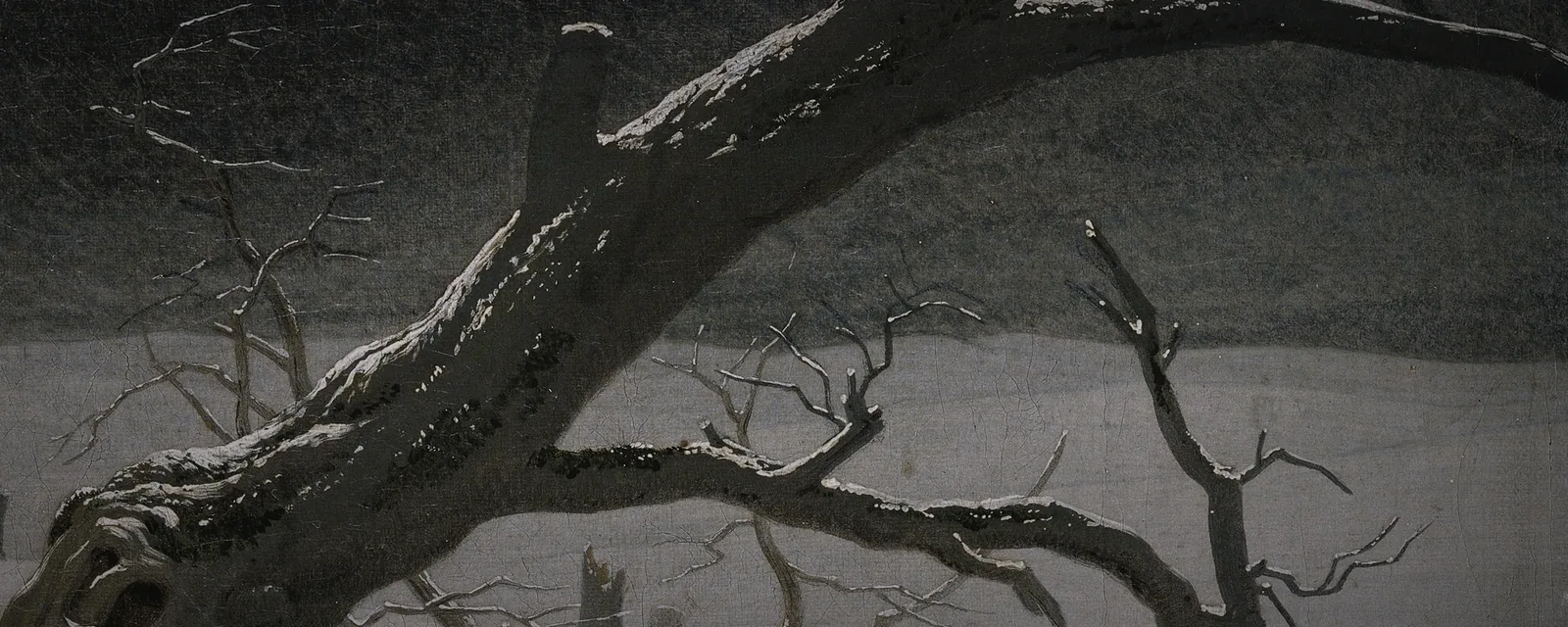
Black metal essay
The Black Legions
Les Légions Noires, French black metal 1993 to 1997, and an aesthetics of withholding
I. A demo given to fewer than ten people
The strongest claim anyone has ever made for the most secretive group in French black metal is the dullest one. On the Metal Archives page for Vlad Tepes, beneath the entry for a demo called Morte lune, dated 4 March 1996, there is a sentence that I have read perhaps thirty times: “Original copies were given to less than ten people.”1
Fewer than ten. Not “limited to a hundred,” that stock phrase of the cult release. Not “a thousand hand-numbered copies” (which exists too, as we will see). Fewer than ten people, handed a cassette by someone they presumably knew, in a pre-internet year, for no commercial purpose. The Metal Archives calls it “the last Vlad Tepes demo.”1 Thirty years after that handful of cassettes went out, a large online encyclopaedia has a page for it, with dates and a note, and Wikipedia has a different year. I will return to the year.
This is a recurring problem for anyone who wants to write about Les Légions Noires, the circle of French underground black metal projects that was active, by most accounts, between 1993 and 1997. The thing wanted not to be written about. The thing has been written about, a great deal, for thirty years. The people who wanted it to disappear are the people the record is now made of, and what the record is made of is mostly other people’s anecdotes.
So the first duty of this essay is to separate what is documented from what is told. I will say clearly which is which, and where sources disagree I will give you the disagreement instead of picking a winner. The reviewer note above lists my main disputes. The second duty is to say why a pessimist should care. The answer I will argue is that this circle, whatever its faults, made one of the cleanest experiments in the history of popular music in the refusal to be for us, in Eugene Thacker’s phrase, and that the experiment is worth reading even by people with no taste for the sound.2
I should say plainly that this is a piece about tapes, pseudonyms and an invented language. It is not an endorsement of any ideology, and where the vocabulary of the scene runs into ugly territory I will mark it and not dress it up.
II. What “the Legion” was, and was not
Les Légions Noires, “the Black Legions,” is the name given to a loose network of French black metal projects, centred in public memory on the city of Brest in Brittany but with members and bands elsewhere, including Bergerac and the Bordeaux area, and Montpellier.3 They were active, in most accounts, between 1993 and 1997. After that, accounts diverge.
The first problem is the word “centred.” English Wikipedia describes the circle as centred in Brest. French Wikipedia and the Metal Archives band pages show something more scattered: Vlad Tepes in Brest, Belkètre in Bergerac, Torgeist near Bordeaux, and Mütiilation listed in Grabels, near Montpellier.4 “Brest” is the capital of the myth. A map of the actual bands would be a diagonal across France.
The second problem is dates. English Wikipedia gives the active years as 1993 to 1997 and then also 2015 to the present. French Wikipedia and the Metal Archives give 1993 to 1997. Wlad Drakksteim of Vlad Tepes said in a 2023 interview that he stopped making music in 1997, after the circle ended.5 The 2015 revival is, as far as I can find, a Wikipedia-only claim. I treat it as unverified. Meanwhile the origin is murky: English Wikipedia says “possibly late 1980s,” and also gives a summer 1993 “occult musical alliance” between Vordb of Belkètre and Meyhna’ch of Mütiilation, with a “citation needed” tag.6 Nobody reliable seems to know the precise date the first person called the circle a legion.
The third problem is the “membership.” A “legion” suggests a roster. What the sources describe is a set of overlapping projects whose members traded tapes, appeared on each other’s recordings, and used a shared set of names and symbols. The Metal Archives notes that “several Torgeist members do not consider themselves part of Les Légions Noires.”7 It says that Belkètre, Zelda and Chapel of Ghouls, often treated as one band, were in fact three distinct ones.8 And it lists a second Black Murder, which turns out to be a different band from the first.9 A reader attempting to draw an org chart will discover that the org chart is the thing the participants most wished not to exist.
What kind of thing, then, was it? In the plainest terms: a circle of young men (the surviving members speak of their “youth”) who made lo-fi black metal on four-track recorders and distributed it in tiny numbers. Dayal Patterson, whose Black Metal: Evolution of the Cult (Feral House, 2013) has a chapter on them, described them in a Vice interview as “one of the most secretive and anti-commercial movements in music.”10 He said releases were “only given to people that were trusted,” and that members “just vanished because all they had was pseudonyms and grainy photos.” Whether you consider that a flattering description is up to you. As a fact about sources, it explains why everyone writing about them is, in effect, quoting the same few people.
one of the most secretive and anti-commercial movements in music
Dayal Patterson, interviewed in Vice, 2013
III. The bands, in a few paragraphs each
The best way to see what the circle produced is to go band by band. I will give releases and dates as the Metal Archives lists them and flag where other sources differ.
Mütiilation
Mütiilation was formed in 1991, according to the Metal Archives and English Wikipedia, as the project of one musician who used the name Meyhna’ch, with drummers who changed over the years. The Metal Archives lists it under the commune of Grabels.11 The early demos are Rites Through the Twilight of Hell (1992), Ceremony of Black Cult (1993) and Satanist styrken (1994).
The key early release is the 7-inch EP Hail Satanas We Are the Black Legions (1994, catalogue 66601, listed as independent), with the credit “recorded during the full moon.” The Metal Archives lists the lineup as Dark Wizzard of Silence on drums, bass and keyboards and Meyhna’ch on vocals and guitar.12 The title is a joke, a declaration and an advertisement at once. The phrase is there on the sleeve a year before the circle’s best-known CDs.
The key release is the full-length Vampires of Black Imperial Blood, issued in September 1995 on Drakkar Productions (catalogue DKCD001) as a CD of 1,000 copies. The Metal Archives gives the track list: “Magical Shadows of a Tragic Past,” “Born Under the Master’s Spell,” “Ravens of My Funeral,” “Black Imperial Blood,” “Eternal Empire of Majesty Death,” “Transylvania,” “Under Ardailles Night,” and “Tears of a Melancholic Vampire,” with a running time of 54:12.13 It was recorded at a place called Black Legions Studio. The credited lineup is Meyhna’ch (vocals, guitars, and drum programming on one track), Krissagrazabeth (drums on tracks one and four through eight), Mørdrëd (bass), and a session drummer on track three. Early versions of tracks one, four, five and seven are on a 1994 demo, Black Imperial Blood (Travel).13
After the core period, Mütiilation’s discography grows long, with Remains of a Ruined, Dead, Cursed Soul in 1999 (a full-length on Metal Archives, a compilation of unreleased material in French Wikipedia and in English Wikipedia’s account, which I flag as disputed), then Black Millenium (Grimly Reborn) in 2001, and several more.14 The project ended by Meyhna’ch’s announcement on 8 December 2009, was revived in 2014 and again in 2024. It has played live rarely. Its first show was on 23 June 2001, according to the Metal Archives, at the Hellfest Drakkar festival in Marseille, which says something about a band of “Black Legions” that waited ten years after its founding to stand on a stage.15
Vlad Tepes
Vlad Tepes, formed in Brest in 1993, takes its name from the Romanian voivode usually known as Vlad the Impaler. Its members are Wlad Drakksteim and Vorlok Drakksteim, with Nifleim credited on drums on the first demo.16 The Metal Archives and French Wikipedia agree on the early run: Rehearsal Winter ‘93 (1993; recorded in Brest from October to December), War Funeral March (cassette, August 1994, five tracks, 20 minutes and 42 seconds, with backing vocals credited to Aäkon Këëtrëh, Krissagrazabeth, Vordb and Meyhna’ch), The Return of the Unweeping (1994), and Celtic Poetry (1994), followed by several 1995 demos including Into Frosty Madness, Brouillons I/II and Dans notre chute...17
War Funeral March is the first of the disputes. The Metal Archives marks it “Independent.” French Wikipedia says that Full Moon Productions issued it, and a 1994 interview in the zine Petrified (issue 3, as quoted on Wikipedia) has Thorns, then of a different band and also running a label, saying he “signed them for a release on Full Moon Productions... called ‘War Funeral March’.”18 These sources cannot all be right, or they describe different editions of the same object. I give both and state the Metal Archives’ attribution of “independent” as the edition I can confirm.
The split releases are where the documentation is best. March to the Black Holocaust is a split between Vlad Tepes and Belkètre, released in November 1995 on Embassy Productions (catalogue TE 002) as a CD of 1,000 hand-numbered copies. It was reissued by Drakkar in February 2013 and has also been bootlegged, per the Metal Archives, by a label called Tragic Empire.19 Black Legions Metal is a split with Torgeist, on Drakkar (DKCD002) in January 1996, in 975 copies, with a note on the Metal Archives that “audio quality [is] very poor due to bad DAT tape transfers.” It was recorded at Black Legions Studio.20 The Metal Archives also lists an earlier 1995 Vlad Tepes demo of the same name, which complicates matters and shows how a name could be recycled across tape and disc.20
Morte lune closes the sequence. The Metal Archives dates it to 4 March 1996 and calls it the last Vlad Tepes demo; English Wikipedia lists La Morte Lune as 1997; French Wikipedia says March 1996 in running text and 1997 in the discography table.21 I report all three. Later releases are reissues and compilations: Anthologie noire (2013), The Drakksteim Sessions (2015) and the 2018 box set A Catharsis for Human Illness (Drakkar, DKLPBOX01).22
Belkètre
Belkètre, formed in 1993 in Bergerac by the musician known as Vordb, along with Lord Aäkon Këëtrëh, is the most musically peculiar project in the circle, and the one whose naming conventions are least translatable. The Metal Archives lists Studio Tracks 1993, The Dark Promise (1994), Twilight of the Holocaust (Studio Tracks 1994), the split with Vlad Tepes (1995), Ambre Zuèrkl Vuorhdrévarvtre (listed as 1996 in the discography and as 1995 in a “read more” note, so the date is disputed), and later releases in 1998, 2015 and 2023.23 The Metal Archives says that six demos were recorded and only three were treated as standalone works.8 French Wikipedia records that an Embassy Productions representative signed an album deal with Belkètre in December 1994.24
Vordb also ran other projects, and the Metal Archives lists several, including Moëvöt (an ambient project; its first demo, Abgzvoryathre, is from 1993), Aäkon Këëtrëh, Amaka Hahina, Satanicum Tenebrae, Brenoritvrezorkre (with fourteen demos), and others.25 The titles are in an invented language, discussed below. The more I read the list, the more I think the dishonesty of calling these “bands” is a symptom of a deeper fact. They were not bands in the sense of an entity that performs for an audience. They were projects in the sense of a desk drawer.
Torgeist, Black Murder and the margins
Torgeist, formed in 1992 in Martignas-sur-Jalle, released the demos Devoted to Satan (1994) and Time of Sabbath (1995), and contributed to the 1996 split with Vlad Tepes. Members listed include Vordb Bathor Ecsed on bass, A Dark Soul on drums, Lord Aäkon Këëtrëh on guitar and Lord Beleth’Rim on guitar and vocals. The name is German, “ghost of the gate” in the Metal Archives’ gloss, and, as noted, several members reportedly do not regard themselves as part of the circle.7
The two bands named Black Murder are a good example of the problem. One of them, associated with Vordb, is listed separately from the one of Vorlok, Wlad and Vordb in Brest (1994 to 1995).9 I cannot tell you which is which with the confidence the genre’s fans bring to such matters, and I have decided not to try.
The infrastructure around them
Two things connected these bands: a cassette and a zine. The compilation tape Morbid Tunes of the Black Angels ran in three parts, the first in April 1994, the second in 1995 and the third in 1996 (the last under the title The Way of Force), per the sources I read.26 And in 1995 Meyhna’ch published a fanzine called The Black Plague: First Chapter (And maybe the last one), which carried interviews with several projects. It is from that fanzine, in an interview with Belkètre, that Edia Connole takes one of the most arresting sentences in the scholarship, which I will return to.27
A short ledger of things nobody agrees about
Because the house style forbids resolving a dispute by guessing, here is the ledger in one place. Each item is a place where a source I read disagrees with another source I read.
- When it began. “Possibly late 1980s” (English Wikipedia), a summer 1993 alliance (English Wikipedia, “citation needed”), 1993 (French Wikipedia and the Metal Archives band pages). Unresolved.
- When it ended. 1996 (the Metal Archives list Vlad Tepes as active 1993 to 1996), 1997 (Wikipedia, and Wlad Drakksteim’s own account). Unresolved. English Wikipedia adds a revival from 2015 that no other source I read supports.
- Where it was. “Centred on Brest” (English Wikipedia), against a diagonal of towns from Brest to Montpellier (the Metal Archives and French Wikipedia). I side with the diagonal as a description of where the bands were, and with “Brest” as a description of the legend.
- Who issued War Funeral March. Independent (Metal Archives); Full Moon Productions (French Wikipedia and a 1994 zine quote).
- When Morte lune is from. 1996 or 1997 (see above).
- When Belkètre’s Ambre Zuèrkl Vuorhdrévarvtre is from. 1995 or 1996.
- What Remains of a Ruined, Dead, Cursed Soul is. A full-length (Metal Archives), or a compilation of unreleased material (both Wikipedias).
- Who counts as a member. Several Torgeist members reportedly reject the label. Belkètre, Zelda and Chapel of Ghouls are three bands, not one (Metal Archives).
- Who the two Vlad Tepes members are to each other. “Artistic brothers” (interviewer’s note); real names “rumored but never confirmed.”
I would like to be able to tell you that the disagreements will be settled when someone finds the right tape. I doubt it. The circle was a scene that worked by gaps, and the gaps have become its form.
IV. How the tapes moved
Think about what it meant to be an underground band in France in 1994. You recorded on a four-track, at home or in a friend’s rehearsal room. You copied cassettes by dubbing, one at a time or two at a time. You sent them by post, with a handwritten letter and perhaps a photocopied flyer, to people whose addresses you had from fanzines. The recipient might send back a cassette of their own, or a letter, or money. The network was a postal service run by the young.
That is not unusual. It is the standard architecture of the global tape-trading underground from about 1980 to about 1995. What was unusual in the case of the Legions was the deliberate narrowing of the circle. Patterson says releases were “only given to people that were trusted.” The Metal Archives says of Morte lune that originals went to fewer than ten. The more official releases came in numbers: 975, 1,000, 1,000. These are small by the standards of the commercial music industry and ordinary by the standards of the underground. The extraordinary thing is that the projects behind them seem to have regarded even these small numbers as a compromise.10
Consider the sequence. A cassette is made, with a handful of copies. Some of the music moves to a split on a small label, in a run of about a thousand. The CD circulates. The tape is copied. A bootleg appears. People pay money for it. The members, in Wlad Drakksteim’s account, begin to feel that their work has been taken from them. In the 2023 interview, he says that his reasons for reissuing material in 2013 were “all the bootleg madness, the prices madness, the lack of respect.”28 The movement that wished to withhold became, against its will, a supply chain.
Patterson makes the point in blunter terms. LLN material is available now, he says, “largely because people betrayed them and shared or bootlegged them.”10 I do not know of a better one-sentence history of the circle’s reception. It also points to the central irony of the withholding strategy. A thing can only be withheld from people who do not already know it exists, and the withholding itself advertises that the thing exists.
I want to be fair to the strategy, since it is easy to mock. A band that sells to a thousand people through a tiny label is not hiding. It is a small business with an unusual brand. What distinguishes the Legions is not the size of the editions but the posture. The posture was to treat the recording as an act with a narrow audience and to refuse the machinery by which the act would be explained. As far as the sources show, there was no promotion beyond underground zines, and no touring. Mütiilation, at least, “rarely performed live.” A band that never performs cannot be photographed on stage.
What they sounded like, and where it came from
I am not a good guide to the sound, and the reader should discount me accordingly. What the sources allow me to say is limited, and I would rather limit myself than borrow adjectives. The Metal Archives remark that the Torgeist and Vlad Tepes split has “audio quality very poor due to bad DAT tape transfers.” Wlad Drakksteim says he later remixed his four-track masters for the reissues.28 So the music was made on a four-track recorder, the transfers were bad, and the later versions were corrected after the fact by the man who made them. That is already a small parable about what happens to a documentary record.
As for ancestry, French Wikipedia quotes a 1994 interview with Wlad in Petrified in which he names Hellhammer and especially Bathory.45 That is the usual early-1990s inheritance, and it is the reason the Legions are properly a part of the history of black metal and not a freak outside it. They came out of the same few records everyone else did, in a country where the genre’s vocabulary was imported. What they did differently was to import it and then close the door.
V. Names that are not names
Everything about the circle’s naming is deliberately unhelpful. The musicians used pseudonyms such as Vordb, Meyhna’ch, Wlad Drakksteim, Vorlok Drakksteim, Krissagrazabeth, Mørdrëd, Aäkon Këëtrëh and Beleth’Rim. They used names for bands that are barely pronounceable, such as Brenoritvrezorkre, Vzaéurvbtre, Vagézaryavtre and Dzlvarv, and for albums that are not clearly in any language, such as Ambre Zuèrkl Vuorhdrévarvtre. Belkètre’s titles are the clearest instance. According to an editor’s note in the 2023 Invisible Oranges interview and to a search synthesis I cannot independently confirm, Vordb’s language is called “Gloatre,” and it is deliberately left untranslated.29
What is this for? Three answers are available, and they are not mutually exclusive.
The first is protection. A teenager making music about forbidden subjects in a provincial French town in the mid-1990s has reasons not to put his name on it. The Invisible Oranges interview mentions a “doxxing attempt,” with names and addresses, in a zine called Kill Yourself. That detail alone, whatever its proportions, explains why a pseudonym felt useful.30
The second is myth. An unnamed musician is a blank onto which a listener can project. Patterson says members “just vanished because all they had was pseudonyms and grainy photos.”10 The pseudonyms did the work that the music alone might not have done: they made the performers characters. The editor of the Invisible Oranges interview notes that the two members of Vlad Tepes were assumed to be brothers and turned out to be “artistic brothers,” and that their real names are “rumored but never confirmed.”31 A myth that can be solved by looking at a birth certificate is a weak one. These ones lasted.
An unnamed musician is a blank onto which a listener can project.
The third is philosophical, and it is the one I find interesting. The pseudonym and the invented language both work as depersonalisation. They remove the person, as an object of curiosity, from the thing that is made. That is a position about authorship. In the interview with Heavy Music HQ, as I noted it, Patterson talks about pseudonyms and corpse paint in black metal generally as a way “to remove the personalities.”32 The point of the exercise is to try to get a piece of music that is not, in the ordinary sense, anyone’s.
I should state the strongest objection. In her chapter “Les Légions Noires: Labor, Language, Laughter,” Edia Connole cites Nick Richardson’s essay “Looking Black,” in Black Metal: Beyond the Darkness (ed. Tom Howells, Black Dog, 2012), on corpse paint. Richardson’s claim is that corpse paint is a way of making “reflections of our personality, not self-erasure.”33 The pseudonym, on this view, is not an erasure of the person but an amplification of a persona. It is a costume, and a costume is, if anything, more personal than a face.
I think both are true, and the circle’s practice supports both. The pseudonym removes a particular kind of curiosity (who is he, what does he do for a living) and creates another (what kind of creature is this). It is less a vanishing act than a transformation of the question. That is not a defect in the strategy. It is the strategy.
VI. Rumour, threat and the manufacture of a myth
If the circle’s main product was withholding, its main by-product was folklore.
The stories can be sorted by reliability. The best-documented are the stories about the recordings, which can be checked against catalogue entries: dates, numbers, labels. The next group are stories about people: who is related to whom, who is the real name behind a pseudonym, who left and why. The sources are conflicting, and many are, quite properly, unsourced. The third group, the stories about behaviour, is the one on which the myth rests.
Patterson, in the Vice interview, makes a comparison that he does not soften: “Like Euronymous, they also sent death threats (and dead rats).” He also says they “also created some of the best black metal ever made,” and, when asked whether the circle still exists, “Probably not.”10 The tone is that of a historian reporting what is said, with a degree of admiration, and with a refusal to endorse the behaviour. I follow it.
The Invisible Oranges interview puts the legend on the record from the side of one participant, and it is worth saying carefully. A rumour holds that Vlad Tepes threatened the owner of the Full Moon Productions label and mailed him dead rats. The Metal Archives’ “read more” note on the band tells a version of the same story from the label’s side. Since both are the label’s version of the events, as far as I can see, they do not amount to independent confirmation, and the story is partisan and one-sided.34 I name neither the label’s owner nor the people said to have threatened him. I record only that the story exists and that it is reported, in the sources I read, as rumour and counter-rumour.
Other legends are cheaper still. The Invisible Oranges editor’s note mentions stories that one of the bands recorded in a castle and that another placed a microphone inside a living rat. I could find no support for either, and I do not repeat them as fact.35
It is worth asking what these stories do. They do not describe the music. They describe a threat level, and they assign it, retroactively, to a body of work that had no way of defending itself from the assignment. A circle that wanted to be unknown is now best known for stories that it did not tell, in which it appears as a gang of anonymous teenagers with a sinister mail service. One suspects that this is the exact portrait of themselves that they would least have chosen, and the only one that would have lasted.
In fairness to the participants, a number of them have said so. Wlad Drakksteim, in the 2023 interview, recalls his youth as “a permanent struggle against myself and the world,” a “spiral of destruction of the limits imposed by... humanity, society, religion, the state, the family,” which ended “like a star collapsing in on itself.”36 That is a retrospective, written by a man in middle age with a different project and a different name, and a good reporter would hold it apart from the material of 1994. But it matters that he reads those years as a struggle, not as a pose.
VII. A pessimist’s reading
Now to the question I promised: why would a person who is not a fan of the music care?
My argument is that the circle’s practice is an unusually pure example of an aesthetic that refuses to be for us. I borrow the phrase from Eugene Thacker’s work on cosmic pessimism, which I take up in a companion essay, and I use it in a limited sense. In the 2010 essay “Three Questions on Demonology,” Thacker proposes that the word “black” in black metal can mean Satanic, pagan, or cosmic, and that the third meaning, “Cosmic Pessimism,” is “a strange mysticism of the world-without-us.”37 Thacker does not mention the Legions. He does not discuss French black metal at all, and I will not pretend that he does. What he supplies is a frame.
Within that frame, the question is: what kinds of art refuse to address their audience? An audience, in the ordinary sense, is a group for whom the work is made. A work that is made for ten people, with names that cannot be pronounced, in a language that does not exist, with a recording quality its own label describes as “very poor,” is a work that has declined most of the conventional ways of being for anyone. It is difficult to listen to. It is not welcoming. It does not explain itself. And its refusal to be useful is the thing about it that survives.
Edia Connole’s chapter in Floating Tomb: Black Metal Theory, which was first presented as a lecture at the University of Southern Denmark in 2015, goes further. I have read only her abstract and footnotes, so I give the argument in outline. She reads the Legions through Nicola Masciandaro’s idea of “Labor, Language, Laughter” (from his essay on Aesop and the apophatic human), through Bakhtin on carnival, through a “monstrous hermeneutics,” and through Wittgenstein.38 What follows is my gloss, not hers: an invented language is not a puzzle to be solved. It can be a joke whose punchline is the reader’s desire for a translation.
One sentence in her chapter does the heaviest lifting, and I give it with a warning. Footnote 31 quotes the 1995 Black Plague interview with Belkètre (p. 13): asked “What would a world created [in] your image look like?”, the answer is “It would be a ‘no’ world. The obliteration of a ‘world’ like the one of the humans.”39 I have only Connole’s quotation, not the fanzine, so this is single-source and I flag it as such. But it is the most precise single statement of the Legions’ pessimism that I have seen. It is a “world-without-us,” in Thacker’s phrase, offered as an aesthetic ideal by a person who has no way of putting it into practice. It is not a political programme. It is the wish of a young man in a provincial town that the whole thing be over.
Is this pessimism? Strictly, no, if pessimism means a thesis. The Legions are a mood in sound. They did not argue anything. They did not make a case for non-existence, they made a noise in praise of it. But the line is thinner than it looks. A great deal of pessimist literature, from Leopardi to Cioran, is a performance in the grammar of argument by someone who does not believe that arguing helps. And Wlad’s closing sentence in the 2023 interview, “witnessing the world’s collapse, waiting for it to end at last,” is a sentence any cosmic pessimist would recognise.40
The weight I would put on it is modest. The Legions are not proof that pessimism has a musical form. They are evidence that a certain kind of young person, in a certain kind of town, at a certain time, found in a particular combination of noise and withholding a way of saying “no” that did not need anyone to hear it. The pessimist can learn from that without agreeing with the lyrics, or even reading them.
Objections
The first objection is that withholding is a marketing strategy. Everyone who has worked in a record shop knows that scarcity sells. A cassette given to ten people becomes, thirty years later, a cult object with a Wikipedia entry. The strategy, if it was one, worked.
The reply is that a strategy needs a goal. Patterson describes the circle as “anti-commercial,” and the evidence suggests that the members sold what they sold in small numbers, did not tour, did not promote, and did not enjoy their later notoriety. Wlad’s complaint about “the prices madness” is the complaint of a man whose work has been turned into stock. If this was marketing, it was the least competent in the history of the form.
The second objection is that the aesthetic cannot be separated from the posture. This is a serious one. The “Satanic” vocabulary, the threats, the “Black Holocaust” title, all of it is part of the package, and an essay that wishes to extract a pessimist aesthetic from the package has to say how.
My answer is limited. I read the vocabulary of the scene as the genre’s stock apocalypse, in the way that the sources I used appear to, and I have not audited the lyrics for content. If someone shows me that a specific lyric promotes a specific hatred, I will withdraw my praise from that lyric. I am not claiming that the circle was blameless. I am claiming that the withholding, which is the subject of this essay, can be assessed separately from the vocabulary. The word “holocaust,” in particular, is used by this genre as a stock word for apocalypse, as in Immortal’s Pure Holocaust (1993), and I record it as a word that makes me uncomfortable, whatever it meant to those who used it.41
The third objection is that all of this is nostalgia. There is a species of black metal writer for whom 1993 is the year of the fall. I am not that writer and I do not think the circle was a golden age. It was a few dozen people making tapes, some of them very good. The music’s reputation has done more for it than its quality. But it is a useful case of an aesthetic of refusal that survived long enough to be studied.
VIII. Afterlife, reissues and the problem of being found
By Wlad Drakksteim’s own account, he stopped making music in 1997, rediscovered the “Internet buzz” around the circle in 2012 or 2013, remixed his old four-track masters, and arranged reissues through Drakkar and another label, Black Gangrene.42 He now has a different project, VarvLoar1476, whose name begins with “Varv Loar,” which means “Morte Lune” in Breton, per the same interview.43 He says he has had no contact with his former bandmate Vorlok since 1997.44
The 2013 Drakkar reissue of March to the Black Holocaust and the 2018 box set are the most visible traces of that second life.22 A cassette given to fewer than ten people had, by that point, turned into a boxed set with a catalogue number, which is a very Western way for a refusal to end.
The essay concerns the tapes of 1993 to 1997. It does not follow the later careers of the bands, and it does not claim that the music of that period tells us anything about what came afterwards.
IX. What a withholding aesthetic is good for
Let me pull the threads together.
The circle produced a body of music that is, by most reports, loud, harsh, badly recorded and sometimes surprisingly melodic. It produced it in tiny numbers. It made its members’ names unknowable and its titles unreadable. It cultivated, or accidentally acquired, a reputation for menace, which the surviving members have treated variously as a joke, a misunderstanding and an embarrassment. And it left behind, through the efforts of others, an archive.
For the pessimist, three things are worth taking.
The first is the experiment. What happens to an art when you remove the audience, the person and the language? The answer, in this case, is that the myth fills in the space. A work that declines to be explained will be explained by others, and the explanations will be worse. A refusal is not a way of being left alone. It is a way of inviting a different kind of attention. The pessimist who writes an aphorism and hopes no one will read it has the same difficulty.
The second is the discipline. The Legions did not argue. They did not issue manifestos, or if they did, I cannot find them. They made a strange sound and put it in an envelope. The pessimist’s temptation is always to explain, to justify, to win. The discipline of silence is more difficult than the discipline of argument, and these musicians, whatever else may be said of them, practised it.
The third is the caution. The refusal was commodified within a decade. The cassette became a catalogue number, the pseudonym a brand, and the withheld thing a topic for conferences. A pessimist should not be surprised, and might be entitled to a dry smile. The world does not want to be refused. It wants to be told what you are refusing so that it can sell you the T-shirt. The circle could not stop that, and nor can the rest of us.
The world does not want to be refused. It wants to be told what you are refusing so that it can sell you the T-shirt.
I began with a cassette given to fewer than ten people. I will end with the arithmetic of that. Thirty years later, a great many more than ten people know about it, and none of them has heard it as the original ten did. That is what withholding is. It is the attempt to keep something from the world, and the world’s reply is to learn its name.
Notes
-
“Vlad Tepes,” Encyclopaedia Metallum: The Metal Archives, https://www.metal-archives.com (band page and discography, entry for Morte lune, accessed 10 November 2026; the band id I used was 975). ↩↩
-
Eugene Thacker, “Three Questions on Demonology,” in Hideous Gnosis: Black Metal Theory Symposium 1, ed. Nicola Masciandaro (CreateSpace, 2010), 186-87 (the world “for us” and the “in itself”). The phrase “refusal to be for us” is mine, not Thacker’s. ↩
-
“Les Légions Noires,” English Wikipedia and French Wikipedia, consulted 10 November 2026; Dayal Patterson interview, Vice, 13 November 2013; Invisible Oranges interview with Wlad Drakksteim, 25 September 2023. ↩
-
Encyclopaedia Metallum: The Metal Archives, https://www.metal-archives.com, band pages for Vlad Tepes, Belkètre (id 4240), Torgeist (id 8209) and Mütiilation (id 2159 for the page; the discography endpoint used a different id), all accessed 10 November 2026; French Wikipedia, “Les Légions Noires.” ↩
-
Jon Rosenthal, interview with Wlad Drakksteim, Invisible Oranges, 25 September 2023. Wlad says he stopped making music in 1997 after the circle ended. The headline of the interview is not recorded in my notes; please add. ↩
-
“Les Légions Noires,” English Wikipedia (the “possibly late 1980s” claim and the summer 1993 “occult musical alliance,” the latter tagged “citation needed” when I read it). ↩
-
“Torgeist,” Encyclopaedia Metallum: The Metal Archives, https://www.metal-archives.com (including the note that several members “do not consider themselves part of Les Légions Noires” and the gloss on the name). ↩↩
-
“Belkètre,” Encyclopaedia Metallum: The Metal Archives, https://www.metal-archives.com (six demos recorded, three treated as standalone; Belkètre, Zelda and Chapel of Ghouls as three distinct bands). ↩↩
-
“Black Murder,” Encyclopaedia Metallum: The Metal Archives, https://www.metal-archives.com (band id 12822 for the Brest band; a second band of the same name is listed separately). ↩↩
-
Andy Capper, interview with Dayal Patterson on Les Légions Noires, Vice, 13 November 2013 (headline not recorded in my notes). Patterson’s book is Black Metal: Evolution of the Cult (Port Townsend, WA: Feral House, 2013; expanded edition, Cult Never Dies, 2024). ↩↩↩↩↩
-
“Mütiilation,” Encyclopaedia Metallum: The Metal Archives, https://www.metal-archives.com; English Wikipedia, “Mütiilation” (formation in 1991 with drummer Dark Wizzard of Silence). ↩
-
“Mütiilation,” Encyclopaedia Metallum: The Metal Archives, https://www.metal-archives.com, discography: Hail Satanas We Are the Black Legions (7” EP, 1994, catalogue 66601). ↩
-
“Mütiilation,” Encyclopaedia Metallum: The Metal Archives, https://www.metal-archives.com, discography: Vampires of Black Imperial Blood (Drakkar Productions, DKCD001, September 1995, 1,000 copies, 54:12); lineup and track notes from the same entry. ↩↩
-
“Mütiilation,” Metal Archives, discography; English Wikipedia and French Wikipedia on Remains of a Ruined, Dead, Cursed Soul (1999). ↩
-
“Mütiilation,” Metal Archives and English Wikipedia (first live show 23 June 2001; split announced 8 December 2009; revivals 2014 and 2024). ↩
-
“Vlad Tepes,” Metal Archives and French Wikipedia (formation in Brest in 1993; members Wlad and Vorlok Drakksteim; Nifleim on the first demo). ↩
-
“Vlad Tepes,” Metal Archives, discography, for Rehearsal Winter ‘93, War Funeral March, The Return of the Unweeping, Celtic Poetry and the 1995 demos. ↩
-
“Vlad Tepes,” Metal Archives (“Independent”); French Wikipedia (“Full Moon Productions”); the Petrified #3 (1994) quotation as given on Wikipedia, which I did not see in the original. The label owner is not named here. ↩
-
“Vlad Tepes” and “Belkètre,” Metal Archives: March to the Black Holocaust (Embassy Productions, TE 002, November 1995; 1,000 hand-numbered copies; Drakkar reissue February 2013; Tragic Empire bootleg). ↩
-
“Vlad Tepes” and “Torgeist,” Metal Archives: Black Legions Metal (Drakkar, DKCD002, January 1996, 975 copies); the earlier 1995 Vlad Tepes demo of the same title is listed separately. ↩↩
-
“Vlad Tepes,” Metal Archives (4 March 1996, “the last Vlad Tepes demo”); English Wikipedia (La Morte Lune, 1997); French Wikipedia (March 1996 in the text, 1997 in the discography table). ↩
-
“Vlad Tepes,” Metal Archives and Wikipedia (Anthologie noire, 2013; The Drakksteim Sessions, 2015; A Catharsis for Human Illness, Drakkar DKLPBOX01, 2018). ↩↩
-
“Belkètre,” Metal Archives, discography and the “read more” note (1995 vs. 1996 for Ambre Zuèrkl Vuorhdrévarvtre); French Wikipedia. ↩
-
“Belkètre,” French Wikipedia (Embassy Productions deal, December 1994). The Embassy representative is not named here. ↩
-
Metal Archives entries for Moëvöt, Brenoritvrezorkre and other projects of Vordb, as listed from the Belkètre page; accessed 10 November 2026. ↩
-
Metal Archives and Wikipedia entries for the compilation cassette Morbid Tunes of the Black Angels (Part 1, April 1994; Part 2, 1995; Part 3, 1996, The Way of Force). Please verify the part dates before publishing. ↩
-
Edia Connole, “Les Légions Noires: Labor, Language, Laughter,” in Floating Tomb: Black Metal Theory, ed. Nicola Masciandaro and Edia Connole (Milan: Mimesis International, 2015), footnotes (the 1995 fanzine The Black Plague: First Chapter (And maybe the last one)). I read the abstract and footnotes only. English Wikipedia and Metal Archives also mention the fanzine. ↩
-
Rosenthal, interview with Wlad Drakksteim, Invisible Oranges, 25 September 2023 (reasons for the reissues, remixing the four-track masters). ↩↩
-
Invisible Oranges editor’s note, 25 September 2023, plus a search synthesis on Vordb’s language; not independently confirmed. The Connole chapter also discusses invented language. ↩
-
Rosenthal, interview with Wlad Drakksteim (the “doxxing attempt” in the zine Kill Yourself). ↩
-
Rosenthal, Invisible Oranges editor’s note on “artistic brothers” and unconfirmed names. ↩
-
Interview with Dayal Patterson, Heavy Music HQ, 27 November 2023. The quoted phrase is from my notes of the interview; verify before publication. ↩
-
Connole, “Les Légions Noires,” footnote 17, citing Nick Richardson, “Looking Black,” in Black Metal: Beyond the Darkness, ed. Tom Howells (London: Black Dog, 2012), 165. I did not see Richardson directly. ↩
-
Rosenthal, interview with Wlad Drakksteim (the editor’s note on the rumour about the Full Moon Productions owner and dead rats); Metal Archives, “Vlad Tepes,” “read more” note. ↩
-
Rosenthal, Invisible Oranges editor’s note. I found no support for the castle or living-rat stories. ↩
-
Rosenthal, interview with Wlad Drakksteim. ↩
-
Thacker, “Three Questions on Demonology,” 186. ↩
-
Connole, “Les Légions Noires: Labor, Language, Laughter,” Floating Tomb (2015), abstract and footnotes; first presented as a lecture at the University of Southern Denmark, 2015 (per the volume’s contents listing on a blog post). ↩
-
Connole, “Les Légions Noires,” footnote 31, quoting the 1995 Black Plague interview with Belkètre (p. 13 of the fanzine). I did not see the fanzine. Single-source; verify. ↩
-
Rosenthal, interview with Wlad Drakksteim (closing line). ↩
-
Metal Archives (titles of March to the Black Holocaust and Twilight of the Holocaust (Studio Tracks 1994)). Immortal’s Pure Holocaust (1993) is mentioned from general knowledge and was not independently checked here; please verify. ↩
-
Rosenthal, interview with Wlad Drakksteim (the “Internet buzz,” Drakkar and Black Gangrene). ↩
-
Rosenthal, interview with Wlad Drakksteim. ↩
-
Rosenthal, interview with Wlad Drakksteim (no contact with Vorlok since 1997). ↩
-
“Les Légions Noires,” French Wikipedia, quoting Petrified #3 (1994); not seen in the original. ↩
Bibliography
Encyclopaedia Metallum: The Metal Archives. Band and discography pages for Belkètre, Black Murder, Mütiilation, Torgeist and Vlad Tepes. https://www.metal-archives.com. Accessed 10 November 2026.
Capper, Andy. Interview with Dayal Patterson. Vice, 13 November 2013.
Connole, Edia. “Les Légions Noires: Labor, Language, Laughter.” In Floating Tomb: Black Metal Theory, edited by Nicola Masciandaro and Edia Connole. Milan: Mimesis International, 2015. (Abstract and footnotes only.)
Interview with Dayal Patterson. Heavy Music HQ, 27 November 2023.
“Les Légions Noires.” English Wikipedia and French Wikipedia. Consulted 10 November 2026.
“Mütiilation.” English Wikipedia. Consulted 10 November 2026.
Patterson, Dayal. Black Metal: Evolution of the Cult. Port Townsend, WA: Feral House, 2013. Expanded edition, Cult Never Dies, 2024. (Chapter not read.)
Rosenthal, Jon. Interview with Wlad Drakksteim of Vlad Tepes. Invisible Oranges, 25 September 2023.
Thacker, Eugene. “Three Questions on Demonology.” In Hideous Gnosis: Black Metal Theory Symposium 1, edited by Nicola Masciandaro, 179-220. CreateSpace, 2010.
Cited only as reported by sources above: Terrorizer 128 (2005); Petrified #3 (1994); Alexandre Guudrath, Anthologie du Black Metal (Camion Blanc, 2012); Nick Richardson, “Looking Black,” in Black Metal: Beyond the Darkness, ed. Tom Howells (Black Dog, 2012).
Two pages from The Whispering Gazette: the Obituaries Spread
PAGE ONE
THE WHISPERING GAZETTE, “Deaths (Names Withheld)”
NAME WITHHELD, 41, of Somewhere Damp, has died, according to someone who may have heard it from someone. Mr. Withheld recorded eleven demos in a bedroom, sent them to nobody, and was in the end discovered by everybody. He is survived by a four-track, which has declined to comment. In lieu of flowers, mourners are asked to bootleg something.
GÉRARD “BLÖKTRE” PLUMEVAUX-MOR, 52, of Lower Brume, died peacefully, probably. Known in the district as “Blöktre,” a name nobody could pronounce including Mr. Plumevaux-Mor, he leaves a language of his own devising, of which the obituary can report that it has no word for “obituary.” A memorial service will be held in a language to be announced.
MADAME SÉRAPHINE DUCRAUX-ÉVEIL, 77, of the Tape-Trading Retirement Cooperative, passed on after a long correspondence. She mailed and received more than two thousand letters, all of which began “Dear Trusted Person.” She is survived by a postal worker who has still not been thanked.
THE LATE ARMAND VESPERLOUP-CHANT, 63, collector. Mr. Vesperloup-Chant spent thirty years chasing a cassette given to fewer than ten people and died on the day he found out he had been the eleventh. The cassette is believed to be in a box. The box is believed to be in a house. The house is believed to be.
CLASSIFIED: LOST. One legion. Black, small, approximately seven strong. Last seen at the edge of a rumour. If found, do not photograph. Do not interview. Reward: none, and please keep it that way.
PAGE TWO
THE WHISPERING GAZETTE, “Our Departed, Not Yet Identified”
OBITUARY ESSAY: THE LATE MARIUS COLOMBEL-NOIR, 49, a man of no fixed photograph. The deceased was known to the public only through a grainy image of what is described by those who have seen it as “a thumb.” For thirty years the thumb gave no interviews. After his death, it gave one, which is being fact-checked. He is survived by an anthology, three box sets, and a price, all of which are higher than he intended.
IN MEMORIAM: THE BRITTANY SOCIETY FOR THE PRESERVATION OF RATS IN THEIR NATURAL CONDITION, disbanded. The Society wishes to state, for the record and for the last time, that it has never been sent by anyone to anyone, and that the rumour of a castle is a rumour. It asks that the rumour be allowed to rest.
IN MEMORIAM: A MICROPHONE, said to have been placed inside a living rat. The rat could not be reached for comment. The microphone is survived by the legend, which grows by about one rat every year.
NOTICES
Auditions. The Society of Unreadable Names seeks a singer whose name cannot be pronounced by any known tongue. Applicants should not apply. We will find you.
Weather. Cold, as expected. Bad quality, as promised.
Horoscope. Cancer: You will be given something small by someone you almost trust. Do not copy it. Everyone will.
Puzzle of the Day. Name the member of the circle who has never been asked for an interview. You have ten seconds, and then you will be the eleventh.
IN LIEU OF AN EDITORIAL: The editors regret that our editorial has been taken down, reissued, remastered, boxed, and sold at a price that we find, in the end, disrespectful.
Humorous and fictional. Every name and place above is invented and refers to no real person, living or dead.
Thanks for reading. More essays, or follow on Instagram.
Notice
Next of Kin
New essays by email when they are filed, with the occasional roundup of 3 AM reviews. Nothing else. Unsubscribe whenever the urge passes.
Confirm by email. No spam, no sharing.