
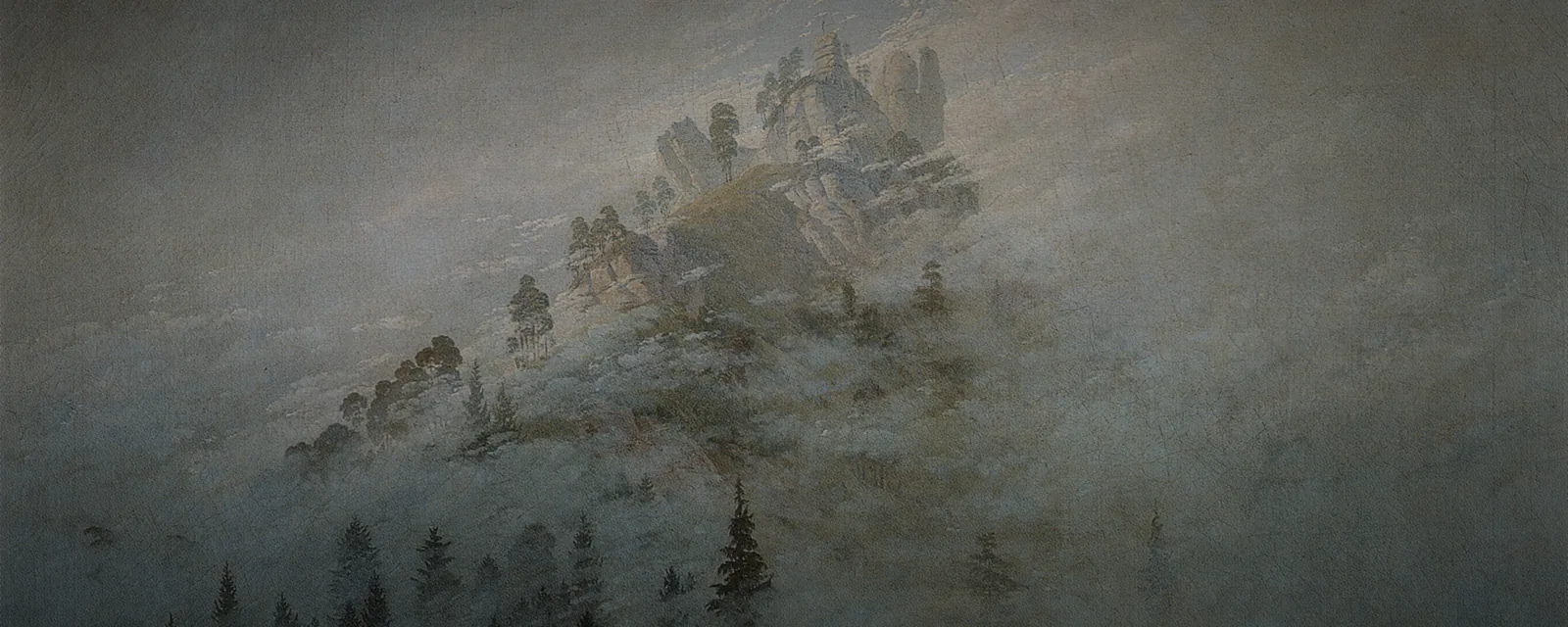
Book essay
The Man Who Asked Life to Ask Nothing
Pessoa’s Book of Disquiet, Bernardo Soares and the dignity of not acting
I. A clerk’s refusal
Here is a man who spends his working days copying figures into ledgers in a Lisbon office, his evenings in a rented room on the same street, and a good part of his nights watching the lamp in somebody else’s window. He has no children and no spouse. He tells us he has never visited a sick friend, and he is proud of it. His morality, by his own account, consists of one rule, which he states with the pleasure of a man reciting the only possession he has not pawned: do no one any harm, and do no one any good.
The man is Bernardo Soares, the credited author of The Book of Disquiet (Livro do Desassossego). The full Portuguese title, as Wikipedia gives it, is Livro do Desassossego: Composto por Bernardo Soares, ajudante de guarda-livros na cidade de Lisboa, composed by Bernardo Soares, assistant bookkeeper in the city of Lisbon.1 The book is a heap of fragments left unedited by Fernando Pessoa, who was born in 1888 and died in 1935 at forty-seven, and it first appeared in Portuguese in 1982.2 Pessoa introduced it as a “factless autobiography.”3
This essay is about one claim that runs through Soares’s fragments like a watermark: that abstaining, declining, refusing to push at the world or at other people, is not only a symptom or an excuse but a position with a kind of dignity. I want to give that claim its best hearing, which means giving its opponents the first word. The case against Soares is easy to make and has a good deal of truth in it. The case for him is harder, and what is left of it after cross-examination is smaller than his admirers like to think and larger than his prosecutors want to admit.
Other pieces in this project argue about whether coming into existence is a harm. Soares is the odd one out. He does not ask that question, and says in one passage I will read that pessimism is an inconvenience. His question is what a person owes, and does not owe, to others and to himself. I do not claim that Pessoa was an antinatalist, or that he anticipated any modern argument, or that his clerk has a politics. I claim only that a certain refusal is on the page, and I would like to know what it is worth.
A statement of footing, because a piece about a famously unstable book owes its reader one. I read the Portuguese of eight fragments in the LdoD Archive, the digital edition run by the University of Coimbra, which publishes expert transcriptions of the manuscripts alongside the numbering used in four printed editions.4 My English renderings of those fragments are my own, and each is marked as such. They are not Richard Zenith’s, nor Margaret Jull Costa’s, nor anyone else’s published translation. The English I can verify to Zenith comes from his own essay in The Paris Review, which quotes passages from the book in English.5 I have not had a Zenith or a Costa volume open in front of me, so I give no page numbers from their printed editions. The numbers I give are the fragment numbers the archive lists for each editor. And a third caution: the archive marks most of these fragments “not attributed” to Soares and dates several only approximately. They are in the book. Whether Soares, or the earlier Pessoan voice, or Pessoa himself speaks in each is a question I do not try to settle. When I write “Soares,” read “the voice of the book.”
II. Who is speaking
It helps to begin with what kind of author Soares is, because the answer should make us wary of anyone who begins a sentence with “Pessoa believed.”
Pessoa wrote under his own name and under a crowd of invented authors who had biographies, styles and philosophies of their own, which he called heteronyms. Soares was not quite one of them. In a letter of 13 January 1935 to the critic Adolfo Casais Monteiro, which Gabriela Silva quotes in Portuguese in a 2025 article, Pessoa called Soares a “semi-heteronym,” and explained that the voice “appears whenever I am tired or sleepy, so that my faculties of reasoning and inhibition are somewhat suspended; that prose is a constant reverie.” It is a semi-heteronym, he said, because the personality, “not being mine, is not different from mine but a simple mutilation of it.” (Both renderings are mine, from the Portuguese Silva prints.)6 The English of Margaret Jull Costa’s translator’s note quotes the same letter and adds a further sentence that Silva’s excerpt does not carry: “It’s me minus reason and affectivity.”7 Take that sentence seriously, and then take it with salt. It is a description Pessoa gave of a character in the last year of his life, about a book he never finished. It is a way of understanding a fiction, not a confession.
The book, too, is not one book. Four printed editions in Portuguese, those of Jacinto do Prado Coelho, Teresa Sobral Cunha, Richard Zenith and Jerónimo Pizarro, order the fragments differently, and the English versions follow different Portuguese ones: Zenith’s 2001 Allen Lane edition follows his own 1998 Portuguese edition, and Costa’s 2017 New Directions edition follows Pizarro’s of 2013.8 A 2017 review of the LdoD Archive by Nicolás Barbosa and Carlos Pittella supplies a neat example. One fragment, beginning “Nunca deixo saber às minhas sensações,” is 296th in Coelho’s sequence, 138th in Cunha’s, 370th in Zenith’s and 46th in Pizarro’s. The archive, they note, encodes 723 fragments.9 George Steiner, in a review of Zenith’s translation for The Observer, wrote that “the fragmentary, the incomplete is of the essence of Pessoa’s spirit,” and that Pessoa “left open-ended” the book at his death; “Nor do we know,” Steiner added, “what parts thereof, if any, he ever intended for publication in some revised format.”10 Zenith himself wrote in the introduction to his earlier English version that Soares’s diary writings are not “the sum total of Disquietude, to which he was after all a johnny-come-lately.”11
Two consequences follow, and they will keep returning. The first is that any “doctrine” of Soares is something a reader assembles, with editorial help, out of pieces that Pessoa never put in order. The second is that the scholars disagree about who even wrote the early layer. Teresa Sobral Cunha, according to Wikipedia, held that there were two authors, Vicente Guedes in the first phase and Soares in the later one; António Quadros thought the first phase was Pessoa himself.12 Gabriela Silva, working only on the Soares phase in Pizarro’s edition, treats the writer as a fictional persona that the text builds as it goes, citing the line, in Pizarro’s edition, in which the speaker says he has become “a book’s figure, a life read” (the Portuguese is uma figura de livro, uma vida lida; Zenith’s English, in his essay, is “the character of a book, a life one reads”).13 A reader who finds in these fragments a fixed ethic of abstention has chosen a path through a maze and then admired the straightness of the path.
I am not saying there is nothing to find. I am saying that the finding is partly the finder’s work, and I will try to point out where that is happening.
III. The case against
Here is the case against Soares, made as strongly as I can make it. Most of it is my own reasoning, and I say so, because I do not want a scholar blamed for an argument she did not make.
It is a symptom, not a doctrine. The likeliest verdict on a man who asks nothing of life and spends his evenings in a rented room is that he is describing a mood, not a morality. Silva, in her article, treats the boredom in the fragments as something that does not harden into a wish to die so much as it feeds “the idea of inertia.”14 A cautious reader can then say: yes, here is a mood rendered with extraordinary skill; but a mood is not an argument, and the dignity of a mood is the dignity of weather. I will not diagnose a fictional clerk, still less a dead poet. The symptom reading is available, and it is not stupid.
It is parasitic. The strongest moral objection is mine and I will put it plainly. A policy of “no harm and no good” works only for someone whose needs are met by people who do act. Soares draws a wage, rents a room, eats in restaurants, and declines to visit the sick. His abstention is paid for by the labour of those he declines to help and by their willingness to go on being useful to him. His own text half admits this, as we will see. A principle of non-intervention is a luxury of those who will never need intervention, and those who need it are exactly the ones for whom the principle is written in no one’s favour.
Not acting is acting. Every philosopher who has recommended abstention has been told this, and it is true. When a man abstains from giving alms, the beggar goes without; when he declines to visit the sick friend, the friend is alone. These are consequences and they are attributable to him. A rule that says “I do not know what the good is, so I do nothing” has quietly decided that doing nothing is the safe default, which is exactly the thing it professes not to know.
The cheap shot, which is still a shot. The prophet of inaction left behind a trunk of papers. Zenith’s essay describes Pessoa’s small bedroom as “overrun by books and papers,” with “papers in his wooden trunk, and books as well as papers piled on the table, the dresser, and the nightstand next to his bed.”15 The Casa Fernando Pessoa, the museum in his last Lisbon home, says the contents of the trunk, which became the Pessoa archive at the National Library of Portugal, include more than 25,000 manuscript sheets. The library’s own catalogue counts 27,691 sheets in the archive as it now stands, plus 251 documents.16 Whatever else this man was, he was not idle. The prosecution will say, with some justice, that a doctrine of not acting is contradicted by the most productive non-actor in Portuguese literature. I will come back to why that is less damaging than it sounds.
The tone. Some of the fragments are not merely abstentious but contemptuous. In one dated 29 March 1930, the speaker says he was born at a time when young people had lost their faith in God and chosen Humanity as a replacement, and that he never accepted Humanity, “being a mere biological idea” signifying nothing but the human animal species and no more worthy of adoration than any other. The cult of Humanity, with its rites of Liberty and Equality, seemed to him a revival of the ancient cults in which animals were gods or gods had animal heads. That is my translation of the Portuguese.17 I will come back to this fragment too, because it also contains the best statement of the whole position. But a reader who wants a clean conscience about Soares should not pretend that his abstention wears a friendly face. In that passage it sneers, and what it sneers at is the egalitarian vocabulary of his century. Whatever dignity the position has, it is not the dignity of a man who is fond of his fellow creatures.
That is the case. It is a good one. If the claim of this essay were that Soares has found a way of living that leaves nobody worse off and has nothing to be said against it, the case would sink the claim in one paragraph. The claim is narrower than that.
IV. The only rule
The passage that matters most for this argument is the one that begins “Assim como, quer o saibamos quer não” (“Just as, whether we know it or not, we all have a metaphysics”). It is dated 18 September 1931, and the archive records that it was published at the time in the journal Descobrimento, number 3, which means that this text, unlike most of the book, reached print in his lifetime; Costa’s translator’s note says that very little of the “intimate diary” was published while he lived.18 It is Zenith’s number 208 and Pizarro’s 335. Gabriela Silva already discusses its refusal of the gift and of the sickroom, so nothing in this section is a discovery; it is a reading.19
What follows is my own English from the Portuguese. I give the structure of the argument first, then the lines, because the structure is where the interest lies.
The passage opens with a general claim: everyone has a metaphysics, and everyone has a morality, whether they like it or not. Then comes Soares’s: “I have a very simple morality: to do no one either harm or good.” There are two reasons for the first half and one for the second.
Why not harm. He recognises in others “the same right that I think belongs to me, not to be bothered,” and he finds that “natural evils suffice for whatever evil there has to be in the world.” Then the ship: “We all live, in this world, aboard a ship that has left a port we do not know for a port we cannot know; we ought to have, toward one another, a traveller’s amiability.”
Why not good. “Because I do not know what the good is, nor whether I am doing it when I think I am.” The rhetorical questions that follow are the heart of the matter: do I know what harm I do if I give alms, or if I educate or instruct? And the conclusion: “In doubt, I abstain.” This is not a vow of selfishness. It is an epistemic policy. It says that benevolent action is a bet on a knowledge of other people’s good that the actor does not have, and that bets of that kind have losers, who are the beneficiaries.
Then he sharpens it, and here the passage stops being a commonplace and becomes strange. “To help or to enlighten is, in a certain way, to do the harm of intervening in another’s life. Kindness is a temperamental whim; we have no right to make others the victims of our whims, even whims of humanity or tenderness. Benefits are things one inflicts; that is why I loathe them, coldly.”
Benefits are things one inflicts; that is why I loathe them, coldly.
Fernando Pessoa, Book of Disquiet, translated for this essay
That last sentence deserves more credit than it usually gets. Set aside the cold loathing. The claim that a benefit is something done to a person, and can therefore wrong them, is a real philosophical claim. Readers of the Benatar essay in this series will remember Seana Shiffrin’s distinction between harms imposed to avert a greater harm and harms imposed to confer a pure benefit, and her suspicion of the second kind when the recipient has not consented.20 I do not claim Soares anticipated her. His is a temperament, not a theory, and his reasons are about whims and privacy, not about consent. But the family resemblance is genuine: the sense that benevolence, unlike mere courtesy, carries a right-claim over its object that no one has conferred.
The next move is the one that makes the whole passage worth reading, because it is where he applies the principle to himself and shows what it costs. “If I do not do good, out of morality, neither do I demand that it be done to me. If I fall ill, what weighs on me most is that I oblige someone to look after me, a thing I would be repelled to do to another.” Then the sentence I have been circling: “I have never visited a sick friend. Whenever, having fallen ill, I was visited, I suffered each visit as an inconvenience, an insult, an unjustifiable violation of my decisive intimacy. I do not like being given things; it seems to oblige me to give them too, to the same people or to others, whoever they may be.”
There it is, and notice what kind of argument it is. It is symmetrical. Soares does not ask to be excused from his duties while exercising his claims; he drops his claims, too. He asks nothing and he gives nothing, and he holds up the symmetry as his defence. This is the best version of the case for him, and I want to give it its due before taking it apart: a person who refuses both to benefit and to be benefited is at least not a free-rider in the ordinary sense. He is trying to leave the economy of obligation altogether. The gift passage is in fact a sharp observation about the gift economy: receiving creates a debt, and debts are what bind us. If you want to be unbound, refuse the present.
Then comes the oddest turn, a self-description: “I am highly sociable in a highly negative way. I am harmlessness incarnate. But I am no more than that, I do not want to be more than that, I cannot be more than that.” He has, he says, “a visual tenderness, an affection of the intelligence,” but “nothing in the heart.” He has “no faith in anything, hope of anything, charity for anything.”
And then: “I abhor, with nausea and astonishment, the sincere of all sincerities and the mystics of all mysticisms.” The nausea becomes “almost physical when these mysticisms are active, when they claim to convince another’s intelligence, or to move another’s will, or to find the truth or to reform the world.” Hold on to this sentence. It does an enormous amount of work. The abstention is not laziness; it is aimed at a particular enemy, the person who has found the truth and wishes to apply it to you. The reformer, the evangelist, the activist with a petition: the object of Soares’s nausea is not the poor man at the door but the man who has a programme. That is a position with a long history and not an unreasonable one. A century as full of programmes as his had some reason to be wary of their authors.
The passage then ends with a series of confessions. He is glad to have no more relatives, because he is not “obliged, as it would inevitably weigh on me, to love someone.” He has “never loved anyone.” What he has loved are his own sensations: states of conscious sight, impressions of waking hearing, scents. He recalls coming from the burial of an uncle “who had loved me so much,” and feeling, vaguely, “the tenderness of a relief, I do not know quite of what.” And he closes: “A passer-by of everything, even of my own soul, I belong to nothing, I desire nothing, I am nothing: an abstract centre of impersonal sensations, a sentient mirror fallen and turned toward the variety of the world. With this, I do not know whether I am happy or unhappy; nor does it matter to me.”21
Read as a whole, it is a more careful piece of ethical reasoning than its tone suggests, and a much less attractive one. The theory has three supports: an anti-paternalist worry (I might be wrong about your good), a privacy worry (my help is an invasion), and a reciprocity worry (a gift is a debt). Each one is real. None of them is nonsense. The conclusion that follows, that the right posture to all of humanity is harmlessness, depends on a fourth premise that is never stated: that the default state of other people is to be fine.
That unstated premise is where the argument fails, and I will say how in Section VII. First there is a second fragment to read, because it supplies what the first lacks.
V. The inn
“Nasci em um tempo” (“I was born in a time”) is dated 29 March 1930. The archive marks it as the opening piece of the book (trecho inicial) and as not attributed. It is Zenith’s number 1 and Pizarro’s 233.22 It is the fragment I quoted for its sneer. Here I want it for the thing it says about the point of withdrawal, which is aesthetic.
The speaker places himself at the margin of his own generation: “the sort of men who are always on the edge of what they belong to, who do not have only the crowd they are part of but also the large spaces beside it.” He could not abandon God as thoroughly as his contemporaries, because “God, being improbable, might be; and so might deserve adoration.” But Humanity, “a mere biological idea,” did not. Hence, “not knowing how to believe in God and unable to believe in a sum of animals,” he and “others of the fringe of the people” arrive at “that distance from everything that is commonly called Decadence.” And then a line that stops the reader: “Decadence is the total loss of unconsciousness, because unconsciousness is the foundation of life. The heart, if it could think, would stop.”
What is left to such a man? In the Portuguese: a renuncia por modo e a contemplação por destino, “renunciation as a manner and contemplation as a destiny.” (The archive’s transcription puts a question mark after the phrase, which signals an uncertain reading of the manuscript, and I note it.) The explanation that follows is the purest form of the case: science’s central precept is that all is subject to fatal laws against which one does not react independently, because “to react is for those laws to have made us react”; and this fits the older precept of divine fatality; therefore, “we abdicate effort as the weak abdicate the pastimes of athletes.”
I find that line (“as the weak abdicate the pastimes of athletes”) wonderfully honest. It does not pretend that renunciation is strength. It describes it as the weak declining a sport they would lose. Whatever the heroic tradition of Stoics and Buddhists might say about conquering desire, this speaker does not claim to have conquered anything. He has declined to enter.
From there the passage turns to what such people do instead: “We bend over the book of sensations with a great scruple of felt erudition,” taking “nothing seriously.” Their writing, “destitute of the wish to convince another’s understanding or move another’s will,” is “only like the reading aloud of someone reading, done to give full objectivity to the subjective pleasure of reading.” Compare the earlier fragment’s nausea at the mystic who wants to “move another’s will.” The two passages are saying the same thing from opposite ends. To write without wishing to convince is to practise, in prose, the abstention that the morality of the ship recommends in life. This is, to my mind, the most durable thing in the position: the idea that it is possible to make something and set it down in the world without asking anyone to agree.
Then comes the best part of the whole book, in my opinion, and the part that most clearly cuts against the lazy reading of Soares as a miserablist. “This is not the pessimists’ conception, like Vigny’s, for whom life is a chain in which he wove straw to distract himself. To be a pessimist is to take something as tragic, and that attitude is an exaggeration and an inconvenience.” (The fragment names only Vigny, presumably the French poet; I take the reference as it stands and build nothing on it.) “We produce our work to distract ourselves, but not like the prisoner who weaves straw to distract himself from Destiny; rather like the little girl who embroiders cushions, to distract herself, and nothing more.”
It deserves to be said slowly: not like the prisoner, but like the little girl. The prisoner weaving straw is a figure of heroic despair, and the pessimist’s art is its monument. The girl embroidering cushions is a figure of unheroic occupation. Soares chooses her, and I think he is right that the choice matters. It removes the tragic dignity that a century of literature has loaned to the despairing artist. It says: this is not a protest against a cosmos; it is a pastime. It is a refusal of the posture of the grand sufferer, which is a posture the neighbouring essays in this series have had occasion to examine. The gloom is not worn; it is not even admitted.
The fragment ends with the image that gives this section its title. “I consider life an inn where I must linger until the coach of the abyss arrives. I do not know where it will take me, because I know nothing. I could consider this inn a prison, because I am compelled to wait in it; I could consider it a place of sociability, because I meet others here. But I am neither impatient nor common.” Others, he says, shut themselves in their rooms, lying soft on the bed where they wait without sleep; others converse in the drawing rooms, “from where music and voices reach me comfortably.” And he: “I sit at the door and soak my eyes and ears in the colours and sounds of the landscape, and I sing slowly, for myself alone, vague songs that I compose while I wait.”
Then the closing: “Night will descend for all of us and the coach will arrive. I enjoy the breeze they give me and the soul they gave me to enjoy it, and I do not question further or seek. If what I leave written in the travellers’ book can, reread one day by others, entertain them too in passing, that will be good. If they do not read it, nor are entertained, that will be good too.”
I will make a claim about this passage, and the claim is the thesis of the essay. The dignity of not acting in Soares is not the dignity of quietism, and it is not that of the saint. It is the dignity of declining to be a salesman. The man at the inn door will not tell the people in the drawing room that they are wrong, will not drag the sleepless man out of his bed, and will not demand that the travellers’ book be read. He sits and listens to the landscape. As a reply to the question “what is a person entitled to do with a life they did not choose,” it is not nothing.23
VI. Asking nothing of life
Two shorter fragments sharpen the point by showing that Soares’s refusal runs in two directions, outward and inward, and that it is more fragile inward.
The first, which the archive titles “O mundo, monturo de forças” (“The world, a dung heap of forces”), is Zenith’s 133 and Pizarro’s 356, dated, with low confidence in the archive, to 1931.24 It begins in cold science: plagues, storms and wars are products “of the same blind force,” operating once through unconscious microbes, once through unconscious lightning and water, once through unconscious men. “An earthquake and a massacre have no difference for me except that between killing with a knife and killing with a dagger.” The world is a “dung heap of instinctive forces, which nevertheless shines in the sun with straw tones of light and dark gold.” To face “the brutality of indifference that is the visible ground of things,” the fragment continues, the mystics discovered that the best course was to repudiate: to deny the world, as the Buddha denied it absolute reality, and as Christ denied it relative reality. The sentence breaks off there, in the manuscript, at a mark the archive renders as a blank box.
And then: “I asked of life only that it ask nothing of me.” (Não pedi à vida senão que ella me não pedisse nada.) The next sentence is the cabin: “At the door of the cabin that I did not have I sat in the sun that never was, and enjoyed my future old age with the pleasure of not having it yet.” (The manuscript shows revisions at this sentence; I follow the cleaner wording in the other expert text the archive prints.)
I want to be careful here. The line is often quoted as a motto. In its manuscript context it is something more interesting, which is a rival to the mystic’s repudiation. The mystics, the fragment says, meet indifference by negating the world. Soares does not negate it. He asks it to leave him alone and sits outside a cabin he does not own, in a sun that does not exist. That is a more modest refusal than the Buddha’s or Christ’s, and a more comic one. The cabin is imaginary and so is the sun. What is real is the posture.
The second fragment is the sad one. “Pedi tam pouco á vida” (“I asked so little of life”) is Zenith’s 6 and 7 and Pizarro’s 193 and 194, dated, with medium confidence in the archive, to 1929.25 It runs: “I asked so little of life, and even that little life denied me. A strip of sun, a nearby field, a bit of peace with a bit of bread, not to be weighed down by knowing that I exist, not to demand anything of others nor they of me. Even this was denied me, like someone who refuses alms not for lack of a good soul but to avoid unbuttoning the coat.”
The abstention, then, is not a thing he is granted. It is something he asks for and is refused. The wish to ask nothing and be asked nothing is, in this fragment, as much a hope as the wish for love, and it fails for the same reason, which is that the world will not agree. The speaker goes on: “I write, sad, in my quiet room, alone as I have always been, alone as I will always be.” And he wonders whether his voice does not embody “the substance of thousands of voices, the hunger to be spoken of thousands of lives.” And then the turn: “But the reaction against myself descends from the intelligence. I see myself on the high fourth floor of the Rua dos Douradores, feeling sleepy; I look at my hand without beauty on the half-written paper, and the cheap cigarette that the left extends over the worn blotter. Here, I, on this fourth floor, interrogating life! Saying what souls feel! Making prose like the geniuses and the famous! Here, I, like this!...”
One detail is worth a note. In this fragment the room is on the fourth floor. In the fragment about Vasques, which I will come to, the rented room is on the second. The text does not say why it moves. It is one more small instruction not to treat Soares as a biography.
VII. What the ledger says back
If the position were as tidy as Section IV makes it sound, there would be no book, only a pamphlet. The reason there is a book is that the same writer keeps taking his own rule to the office and watching it fail. Four fragments do this, and I will take them in order of how much damage they do.
The office boy. “Foi-se hoje embora” (“He left today”) is dated 16 December 1931. It is Zenith’s number 279 and Pizarro’s 346.26 My English follows. “He left today, they said for good, for the land that is his native one, the so-called office boy, that very man I had been in the habit of seeing and hearing as part of this human house, and therefore as part of me and of the world that is mine. He left today. In the corridor, meeting by chance for the expected surprise of the farewell, I gave him an embrace, shyly returned, and I had enough counter-soul not to cry, as, in my heart, my warm eyes wished to for themselves.”
Then the principle: “Everything that was ours, even if only through the accidents of company or sight, because it was ours becomes us.” What left for a Galician land the writer knows nothing of “was not, for me, the office boy: it was a vital part, because visual and human, of the substance of my life. I was diminished today. I am no longer quite the same.” And again, as a general law: “Everything that happens where we live happens in us. Everything that ceases in what we see ceases in us.”
The refrain, “the office boy has left,” returns four times, like a man pressing a bruise. The writing, he says, continues: “I have no soul to work except because I can, with an active inertia, be a slave to myself.” Then the glance forward: “Yes, tomorrow, or when Destiny says, what pretended in me that it was I will have an end.” And the closing line, which I will not translate cleverly: “Today the tragedy is visible through its lack, sensible through not deserving to be felt. My God, my God, the office boy has left.”
Consider what the passage does to the sick-friend sentence in Section IV. The man who has never visited a sick friend, and who suffered every visit to himself as an insult, is undone by the departure of a man he does not name. This is not a contradiction, and I would be cheap to call it hypocrisy. The rule of “Assim como” concerned what he is entitled to do to others, and it said nothing about what other people are entitled to do to him by merely existing near him. The office boy did nothing. He was there, and then he was not, and the clerk’s self shrank. The moral of the fragment is the opposite of the moral of the rule: not “I owe no one anything,” but “others are made into my substance without my consent.” “Everything that was ours becomes us” is a plain refutation of the ship metaphor. On a ship, one has a traveller’s amiability toward strangers. Here one is part of them.
Notice how little the embrace costs: one shy hug, tears withheld, and the withholding reported as an achievement. If the position has a heroism, it is this small and slightly ridiculous one: a person is wrecked, and sits down and does the work.
The boss. The fragment “O patrão Vasques” (Zenith’s 8 and 9, Pizarro’s 350) contains the best joke in the book, though it is told in the tone of a man discovering something. “Ah, I understand! Mr. Vasques the boss is Life. Life, monotonous and necessary, commanding and unknown. This banal man represents the banality of Life. He is everything to me, from outside, because Life is everything to me, from outside.” And then: “And if the office on the Rua dos Douradores represents Life for me, this second floor of mine, where I live, on the same Rua dos Douradores, represents Art. Yes, Art, which lives on the same street as Life, but in a different place; Art that relieves one from life without relieving one from living, which is as monotonous as life itself, but only in a different place. Yes, this Rua dos Douradores comprehends for me the whole sense of things, the solution of all enigmas, except that there are enigmas, which is what cannot have a solution.”27
This is the parasitic objection, delivered by the defendant. The clerk’s inner life, the art, the contemplation, the whole abstention, takes place two doors from the employer who pays for it. Soares does not pretend otherwise. He does not call Vasques a tyrant, and he does not say he would quit if he could. He says that the street contains everything. I decline to make a political economy out of this joke, because it would be a larger weight than the joke can bear. What I will say is that a man who withdraws from the world in the next room to the world’s payroll cannot claim to have escaped the exchange. His dignity, if any, is that he knows it and says so.
The rereading. “Releio lúcido, demoradamente” (“I reread, lucid, slowly”) is Zenith’s 169 and Pizarro’s 372, dated with low confidence to 1931.28 “I reread, lucid, slowly, passage by passage, everything I have written. And I find that all of it is null and that it would have been better if I had not done it.” The attained things, “whether empires or phrases,” have by their attainment “that worse part of real things, which is that we know them to be perishable.” But that is not what hurts. “What hurts me is that it was not worth doing it, and that the time I lost on what I did I gained only in the illusion, now undone, that it had been worth doing.”
Then the sentence that has been quoted too often to be quoted well: “Everything we do, in art or in life, is the imperfect copy of what we thought to do.” It “falls short not only of external perfection but of internal perfection; fails not only the rule of what should be but the rule of what we judged it could be. We are hollow not only inside but also outside, pariahs of anticipation and of promise.” The fragment ends in the image of his dolls bursting and the straw coming out of their seams.
This is the cheap shot turning on the shooter. The prosecution said: you filled a trunk with papers. The defendant answers: and on rereading, it is nothing. The abstainer does not take refuge in the work; the work, too, is something he cannot trust. I read the two fragments together as one position about making: the making is a pastime that has value while it lasts (the “winged moment in which [the prose] was born to me, faster than the movements of the pen”), and the made thing has no value at all.
The papers. The fragment “Que me pesa que ninguém leia” (“What does it weigh on me that no one reads?”) is Zenith’s 118 and 224 and Pizarro’s 378 and 379, again dated with low confidence to 1931.29 It is very short. “What does it weigh on me that nobody reads what I write? I write to distract myself from living, and I publish because the game has that rule. If tomorrow all my writings were lost, I would be sorry, but, I believe, not with the violent and mad sorrow that would be expected, since my whole life went into all of that. Is it not certain, then, that the mother, her child dead, months later already laughs and is the same? The great earth, which serves the dead, would serve, less maternally, those papers. None of it matters.” (The fragment goes on, in a sentence I leave out, to an image of life as a child kept awake and of the longing for the quiet after it has gone to bed.)
The mother is a hard line, and I do not take it as a statement about how grief works, which I do not know and he does not know either. I take it as a statement about how he proposes to hold his own work: loosely, and without the sense of its being sacred. The comparison is not kind to anyone. It is, however, the logical end of the nursery image of Section V. Whoever embroiders a cushion to distract herself need not take the cushion to the grave.
Put the four together and they give a more honest account than “Assim como” can give alone. The rule says: I owe nothing and ask nothing. The office boy says: I am made of the people I see. The boss says: the withdrawal runs on wages. The rereading says: the retreat’s own product is dust. If this is a philosophy, it is one that includes its own cross-examination.
VIII. The lamp
There is one fragment that seems to answer the whole question differently, and it is not one of the eight I read in the archive. It is the passage that Richard Zenith builds his essay in The Paris Review around, written, he says, on 8 September 1933. Zenith is careful: “Whether the experience described in a passage for the book written on September 8, 1933, happened in fact or only in Pessoa’s imagination makes little difference, but I will suppose it to have been factual.” In the passage as he presents it, the writer looks out of a window at a sleeping city and sees one lit window, high up, in the distance. All the others are black. The English he gives is this:
An invisible thread links me to the unknown owner of the lamp. It’s not the mutual circumstance of our both being awake; in this there can be no reciprocity, for my window is dark, so that he cannot see me. It’s something else, something all my own that’s related to my feeling of isolation, that participates in the night and in the silence, and that chooses the lamp as an anchor because it’s the only anchor there is.
Zenith’s gloss is that Pessoa, “who had always cringed at the mere idea of belonging to a collective, any collective,” here configured “an absurdly tenuous form of solidarity: isolated individuals who, enveloped by silence and mystery or perhaps mere nothingness, realize that there are others immersed in that same mystery or nothingness.”30 I am not the first to read the passage this way; Zenith got there, and I acknowledge the debt. But I want to put it next to the rule of 1931 and see what it does.
The relation described is a perfect relation for an abstainer. It is a bond with someone who does not know you exist. It makes no demand on either party. It cannot oblige, because no gift is exchanged; it cannot intrude, because no one is seen; it cannot be disappointed, because it hopes for nothing. It is solidarity in the limit case where solidarity costs nothing. A person who has defined his morality as “do nothing to anyone” can have, at the end of that definition, exactly this: a lamp and a window.
I do not mean that as a sneer, or only as one. It is the least that can be asked of an ethics that has decided not to act. It says that even someone who owes nothing and expects nothing may notice the others on the ship. The traveller’s amiability, the one positive clause he allowed himself in “Assim como,” does not disappear. It shrinks to a glance.
IX. What survives
Now to say what the position is worth, in three parts, because a single verdict would hide the differences.
As a rule against imposing: it survives, with qualifications. The best thing in Soares is his nausea at the person who wants to “move another’s will” or “reform the world.” The claim that one should not treat others as the material for one’s own improvements, that benefits can be impositions, that kindness can be a whim, that the one who gives has to ask whether the receiver wanted it, is not eccentric. It is a respectable ethical position. It is also, on the evidence of the office-boy fragment, a position that the speaker holds only about his acts, not about his attachments, and that distinction is right. The qualification is about those who cannot refuse the benefit: children, the very ill, the very old, who are not in a position to say “I do not like being given things.” For them, the rule of abstention is no rule at all. It is abandonment with a good conscience. In the fragments I read, Soares does not address them, and the omission is the largest hole in his morality.
As a stance toward the crowd: it survives as an aesthetic, not an ethic. To live “on the margin of what one belongs to,” to refuse the cult of Humanity and its rites, is a perfectly good way to spend an afternoon and a bad way to run a society. I have said that the fragment sneers. It sneers at a vocabulary that, in the century that followed, a great many people found it necessary to defend, with their lives. The reader is allowed to love the sentences and to find the sneer unforgivable. The two reactions are compatible, and I feel both.
As quietism toward suffering: it fails, and fails by its own evidence. The clerk’s “natural evils suffice for whatever evil there has to be in the world” is a good argument for not adding evils to the world. It is not an argument for leaving the existing ones to their work. The man who asks of life only that it ask nothing of him is told, in “Pedi tam pouco á vida,” that even this is refused; and he is told again in the office, when a man he never named walks down a corridor and takes part of him away. The world is not a counterparty that signs the contract. A man who says “I will do nothing to you and I ask nothing of you” is making an offer to a party who has not agreed to the terms.
A man who says “I will do nothing to you and I ask nothing of you” is making an offer to a party who has not agreed to the terms.
The dignity of not acting, then, is real but thin. It is the dignity of declining to sell: of sitting at the inn door, listening to the landscape, and leaving the people in the drawing room to their music. It deserves respect when the alternative is the missionary, the reformer, the person who knows what is good for you. It does not deserve respect when it is used to refuse a hand to someone who is drowning, and Soares, to be fair to him, never claims it does. In the fragments I read he has no theory of the drowning man, only the ship and a rule of civility.
The dignity of not acting in Soares is the dignity of declining to be a salesman.
I began with the sick friend. I will end by observing that someone in Soares’s life must have been the friend who visited him when he was sick, since he reports being visited. He called each visit an insult. He also remembered it, enough to write the sentence. That is the paradox of the whole book, and I find it consoling: he asked life to ask nothing of him, and he spent it writing down, for strangers, in the hope or not of being read, what it had asked. “If they do not read it, nor are entertained, that will be good too.” It is good. It would also, I think, have been good to be read.
If any of this is close to something in your own life, and you are in the United States, you can call or text 988, the Suicide and Crisis Lifeline, at any hour. It is free and confidential, and you do not have to be in crisis to use it. If you are elsewhere, your local emergency number or crisis line does the same job.
Notes
-
“The Book of Disquiet,” Wikipedia, https://en.wikipedia.org/wiki/The_Book_of_Disquiet (opening paragraph), read 10 November 2026. Silva, “Scriptor e persona,” 2 n. 2, prints the heading as Pizarro gives it (“Do Livro do Desasocego, composto por Bernardo Soares, ajudante de guarda-livros na cidade de Lisboa”), in a variant spelling; see the bibliography for the full citation. ↩
-
Wikipedia, “The Book of Disquiet,” “Editions” section (first published in Portuguese in 1982; “the author died at age 47 in 1935”) and the opening paragraph (Pessoa, 1888 to 1935). The 1982 date and the 1935 death are corroborated by Margaret Jull Costa’s translator’s note (“from 1912 until his death in 1935, although the first complete Portuguese edition only appeared in 1982”), which I saw only as a search-result excerpt of an online copy, not in the book itself. The birth year 1888 rests on Wikipedia alone. ↩
-
Wikipedia, “The Book of Disquiet,” opening paragraph (“factless autobiography”). This phrase rests on Wikipedia alone; I did not find a second source. ↩
-
Manuel Portela and António Rito Silva, eds., LdoD Archive / Arquivo LdoD (Coimbra: Centre for Portuguese Literature, University of Coimbra), https://ldod.uc.pt/. The eight fragments used here were read in the archive’s expert transcriptions and re-fetched on 10 November 2026: Fr244, Fr301, Fr131, Fr071.a, Fr230, Fr066, Fr136 and Fr159.b. Barbosa and Pittella, “The Website of Disquiet,” 725 and 727, describe the archive’s design. ↩
-
Richard Zenith, “A Literature on the Brink of Dawn,” The Paris Review (blog), 30 July 2021, https://www.theparisreview.org/blog/2021/07/30/a-literature-on-the-brink-of-dawn/. Read in full on 10 November 2026. The essay does not label each English rendering as its author’s own; Zenith is the translator of the 2001 Allen Lane edition, so I attribute the renderings to him with that caution. ↩
-
Gabriela Silva, “Scriptor e persona: a construção da figura ficcional de Bernardo Soares em o Livro do Desassossego de Fernando Pessoa,” Letras 33, no. 69 (2025): 2 n. 1, https://periodicos.ufsm.br/letras/article/download/88108/66458, quoting Pessoa’s letter to Adolfo Casais Monteiro of 13 January 1935. Silva cites arquivopessoa.net/textos/2700 for the letter; I did not open that page, so the Portuguese is as Silva prints it. ↩
-
Margaret Jull Costa, translator’s note, in Fernando Pessoa, The Book of Disquiet, ed. Maria José de Lancastre (London: Serpent’s Tail, 2010; translation first published 1991). Seen only as two search-result excerpts of online copies of the book; I have not read the volume. The sentence “It’s me minus reason and affectivity” and the English of the “semi-heteronym” clause are as those excerpts give them. ↩
-
Wikipedia, “The Book of Disquiet,” “Translations into English” section (Zenith, Allen Lane, 2001, based on the 1998 Assírio & Alvim edition; Costa, New Directions, 2017, based on Pizarro’s 2013 Tinta-da-china edition). Wikipedia alone supports the pairing of each English version with its Portuguese base; the four-editor division of the Portuguese editions is confirmed by Barbosa and Pittella, 727. ↩
-
Nicolás Barbosa and Carlos Pittella, “The Website of Disquiet: The First Online Critical Edition of Fernando Pessoa,” Pessoa Plural 12 (Fall 2017): 727 (the fragment-position example) and 725 (the count of 723 encoded fragments, as of the review’s access date of 16 November 2017). Read in full. The archive’s count may have changed since. ↩
-
George Steiner, “A Man of Many Parts,” The Observer, 3 June 2001, as quoted in Wikipedia, “The Book of Disquiet,” “Interpretations” section. I did not open the original review, so the quotation is as Wikipedia gives it. ↩
-
Richard Zenith, introduction to The Book of Disquietude (Manchester: Carcanet, 1991), xi, as quoted in Wikipedia, “The Book of Disquiet,” “Interpretations” section. I have not seen the introduction itself. ↩
-
Wikipedia, “The Book of Disquiet,” “Interpretations” section (on Teresa Sobral Cunha’s two-author view and António Quadros’s disagreement). Single source; I state it as Wikipedia reports it. ↩
-
Silva, “Scriptor e persona,” 6, quoting Pizarro’s 2013 edition, 388 (Tornei-me uma figura de livro, uma vida lida); the English “the character of a book, a life one reads” is from Zenith, “A Literature on the Brink of Dawn.” Silva’s reading of Soares as a constructed persona is on 6 to 7 and at the conclusion. ↩
-
Silva, “Scriptor e persona,” 12 (“alimenta a ideia da inércia”), where she notes that the boredom “não consolida um desejo de suicídio.” ↩
-
Zenith, “A Literature on the Brink of Dawn” (the description of the bedroom on Rua Coelho da Rocha, with the wooden trunk). Zenith presents the 1933 scene as his own supposition of fact. ↩
-
“Life,” Casa Fernando Pessoa, https://www.casafernandopessoa.pt/en/fernando-pessoa/life (“over 25,000 manuscript sheets”); Biblioteca Nacional de Portugal, Arquivo de Cultura Portuguesa Contemporânea, “PESSOA, Fernando,” https://acpc.bnportugal.gov.pt/espolios_autores/e03_pessoa_fernando.html (27,691 sheets plus 251 documents); Wikipedia, “The Book of Disquiet,” photograph caption (more than 25,000 pages). ↩
-
LdoD Archive, Fr301, “Nasci em um tempo,” dated 29 March 1930 (Zenith 1; Pizarro 233; Coelho 192; Cunha 338), transcribed from BNP/E3, 4-38r to 39r. The English is mine. The relevant Portuguese is: “a Humanidade, sendo uma mera idéa biologica, e não significando mais que a especie animal Humana, não era mais digna de adoração do que qualquer outra especie animal. Este culto da Humanidade, com seus ritos de Liberdade e Egualdade, pareceu-me sempre uma reviviscencia dos cultos antigos.” ↩
-
LdoD Archive, Fr244, “Assim como, quer o saibamos” (Zenith 208; Pizarro 335; Coelho 239; Cunha 597), dated 18 September 1931; the archive lists the witnesses BNP/E3, 4-17-18 and 4-19, and the original publication in Descobrimento, no. 3. Costa, translator’s note (see note on the semi-heteronym), for “Very little of this ‘intimate diary’ was published in his lifetime.” ↩
-
Silva, “Scriptor e persona,” 5, which quotes the sick-friend, gift and “feliz por não ter já parentes” lines of this passage from Pizarro’s 2013 edition. Silva’s quotation corroborates the archive’s Portuguese for those lines; the English throughout my discussion is mine. ↩
-
On the pure-benefit distinction, see Section VIII of the essay on Benatar’s asymmetry in this series, which discusses Seana Valentine Shiffrin, “Wrongful Life, Procreative Responsibility, and the Significance of Harm,” Legal Theory 5, no. 2 (1999): 117-148, at 135-139 (read there in part, as that essay states). I draw only a family resemblance, not a claim of influence. ↩
-
LdoD Archive, Fr244 (see above), for the quotations in this section; the line about the burial of the uncle is in the final paragraphs. All English in this section is my own translation. The Portuguese uses em dashes in “não fazer a ninguém nem mal nem bem” and “de tudo, até de minha própria alma”; I have replaced them with colons and commas in my rendering and do not reproduce them. ↩
-
LdoD Archive, Fr301 (see above). The archive’s “Heterónimo” field reads “Não atribuído,” its “Nota” reads “trecho inicial,” and it places the passage as no. 1 in Zenith’s ordering. The question mark after “contemplação por destino” is the transcribers’ marker of an uncertain reading. ↩
-
The English throughout this section is my own translation of the transcription in LdoD Archive, Fr301. The fragment contains a second, shorter closing passage that I quote at the end of the section; it is part of the same archive record. ↩
-
LdoD Archive, Fr131, “O mundo, monturo de forças” (Zenith 133; Pizarro 356 and 633; Coelho 490; Cunha 578), dated 1931 (low confidence), from BNP/E3, 2-58r and 59r; “Não pedi à vida senão que ella me não pedisse nada” reads identically in the archive’s second expert text for the fragment (the Cunha edition text, https://ldod.uc.pt/reading/fragment/Fr131/inter/Fr131_WIT_ED_CRIT_SC), which also gives the cleaner “gozei a velhice futura com o prazer de a não ter ainda.” Silva, 12, quotes the sentence in a form that omits the accent and spelling of the other texts. English mine. ↩
-
LdoD Archive, Fr071.a, “Pedi tam pouco á vida” (Zenith 6 and 7; Pizarro 193 and 194; Coelho 81 and 89; Cunha 425 to 427), dated 1929 (medium confidence), from BNP/E3, 1-79v. The archive carries Pizarro’s note that it is hard to say whether these notes are an addition to document 1-79 or an independent text. A modernised-spelling Portuguese text of the same passage appears in the Biblioteca Digital edition (https://bibliotecadigital.ebsqf.pt/download/46/Livro%20do%20Desassossego%20-%20Fernando%20Pessoa.pdf), which I saw only as a search-result excerpt. English mine. ↩
-
LdoD Archive, Fr230, “Foi-se hoje embora” (Zenith 279; Pizarro 346; Coelho 158; Cunha 625), dated 16 December 1931, from BNP/E3, 3-82r. English mine. ↩
-
LdoD Archive, Fr066, “O patrão Vasques” (the continuation, beginning “Ah, comprehendo!”; Zenith 8 and 9; Pizarro 350; Coelho 91 and 155; Cunha 412 and 415), from BNP/E3, 1-73r and 2-4r, read in the archive’s “Arquivo LdoD” virtual edition text. The archive carries the continuation as a separate witness; I have not read the preceding section on its own. English mine. ↩
-
LdoD Archive, Fr136, “Releio lucido, demoradamente” (Zenith 169; Pizarro 372; Coelho 321; Cunha 518), dated 1931 (low confidence), from BNP/E3, 2-64r. English mine. ↩
-
LdoD Archive, Fr159.b, “Que me pesa que ninguem leia” (Zenith 118 and 224; Pizarro 378 and 379; Coelho 222 and 506; Cunha 540), dated 1931 (low confidence), from BNP/E3, 2-89 and 3-2r. The manuscript text includes the writer’s insertions, which the archive prints between slashes; I give the sense of the clean reading. The sentence about the mother has no question mark in the transcription; I read it as a rhetorical question, which is an interpretation. English mine. ↩
-
Zenith, “A Literature on the Brink of Dawn.” The block quotation and the sentences quoted in the gloss are as printed in the essay, which attributes the lamp passage to 8 September 1933; I did not locate that passage in the archive or in a printed edition. ↩
Bibliography
Barbosa, Nicolás, and Carlos Pittella. “The Website of Disquiet: The First Online Critical Edition of Fernando Pessoa.” Pessoa Plural 12 (Fall 2017): 725-732.
Pessoa, Fernando. The Book of Disquiet. Edited by Maria José de Lancastre. Translated by Margaret Jull Costa. London: Serpent’s Tail, 2010. (Translator’s note seen only as search-result excerpts.)
Pessoa, Fernando. The Book of Disquiet. Edited and translated by Richard Zenith. London: Allen Lane, 2001. (Cited by fragment number only, through the LdoD Archive; the printed volume was not consulted.)
Pessoa, Fernando. The Book of Disquiet: The Complete Edition. Translated by Margaret Jull Costa. New York: New Directions, 2017. (Based on Jerónimo Pizarro’s 2013 edition; not consulted.)
Pessoa, Fernando. The Book of Disquietude. Translated by Richard Zenith. Manchester: Carcanet, 1991. (Introduction quoted only as Wikipedia reports it.)
Portela, Manuel, and António Rito Silva, eds. LdoD Archive / Arquivo LdoD. Coimbra: Centre for Portuguese Literature, University of Coimbra. https://ldod.uc.pt/. Fragments Fr066, Fr071.a, Fr131, Fr136, Fr159.b, Fr230, Fr244 and Fr301, read 10 November 2026.
Shiffrin, Seana Valentine. “Wrongful Life, Procreative Responsibility, and the Significance of Harm.” Legal Theory 5, no. 2 (1999): 117-148. (Read in part; see the Benatar essay in this series.)
Silva, Gabriela. “Scriptor e persona: a construção da figura ficcional de Bernardo Soares em o Livro do Desassossego de Fernando Pessoa.” Letras 33, no. 69 (2025): 1-14. https://periodicos.ufsm.br/letras/article/view/88108.
Steiner, George. “A Man of Many Parts.” The Observer, 3 June 2001. (Quoted only as Wikipedia reports it.)
“The Book of Disquiet.” Wikipedia. https://en.wikipedia.org/wiki/The_Book_of_Disquiet. Read 10 November 2026.
Zenith, Richard. “A Literature on the Brink of Dawn.” The Paris Review (blog), 30 July 2021. https://www.theparisreview.org/blog/2021/07/30/a-literature-on-the-brink-of-dawn/.
The Second-Floor (or Possibly Fourth) Gazette: The Obituaries Spread
PAGE ONE
THE SECOND-FLOOR (OR POSSIBLY FOURTH) GAZETTE “Neither harm nor good since the first edition.” Weather: overcast, with a chance of being asked to a christening.
DEPARTURES, NON-ATTENDANCES & MINOR INCONVENIENCES
MR. AMBROSE QUILLINGTON-NAY, 61, assistant sub-deputy bookkeeper at the firm of Hobble & Fennimore, died on Tuesday after what colleagues called “a long and entirely uneventful tenure.” Mr. Quillington-Nay declined his own retirement party on the grounds that attending it would oblige him to attend those of others. The party went ahead without him and was, by general agreement, the best the firm has ever held. He leaves no flowers, having asked that none be sent, and two hundred people who sent them anyway and are now in his debt.
MRS. PHILOMENA HARTSWORTHY-DUNN, 84, chair of the Little Dither Society for Visiting the Sick, died Thursday, surrounded by visitors. “She would have hated it,” said her niece, “which is how we knew we were doing it right.” Mrs. Hartsworthy-Dunn made 11,400 hospital visits in forty years and is believed to have given eleven thousand people the sensation of an inexcusable violation of their decisive intimacy. She is survived by a bunch of grapes, which no one has been able to return.
DR. CORNELIUS BEEFWHISTLE, 52, motivational speaker and founder of the Institute of Active Mysticism, died on stage, mid-slogan, at the peak of his potential, according to his press office. Dr. Beefwhistle spent twenty years trying to convince the intelligence of others and move the will of others and reform the world, and his audiences, though sorely tried, report that they did not once feel better for it. His last words, “Let’s get this room moving,” were followed by what attendees describe as an extremely still room.
MISS ODALYS FRENNICK-HOLT, 38, of the second floor, or possibly the fourth, died quietly in her sleep, having asked of life only that it ask nothing of her. Life, which does not read contracts, asked her for a rent increase. She is survived by a cabin she did not have, a sun that never was, and an old age she enjoyed in advance. Services will be held at the door of the cabin. Please bring your own sun.
A CORRECTION. The Gazette regrets that last week’s obituary of Mr. Tobias Wren-Pelham, who was reported as “having left today, definitively, for the land of his birth,” was in fact a clerical error. Mr. Wren-Pelham has been at his desk since March and says he wishes he had not been missed.
PAGE TWO
YOUR GAZETTE GUIDE: WHAT TO SAY TO A MAN WHO HAS NEVER VISITED YOU IN THE HOSPITAL
By our Etiquette Desk. Compiled with the cooperation of several people who were visited anyway.
- “Thank you for not coming.” Sincere, and received as the compliment it is.
- “I brought you a present.” Do not. A present is a debt, and he will have to give one back, to you or to someone else, whoever they may be.
- “You must be so lonely.” He will say he is highly sociable in a highly negative way. Do not ask what that means. He does not know either.
- “But what about the greater good?” He does not know what the good is, nor whether he is doing it when he thinks he is. He will say “in doubt, I abstain,” and the meeting will be adjourned for want of anyone willing to chair it.
- “Why not do a little something?” This is the question that ruined the last three dinner parties. Do not ask it before the soup.
- “We would like you to be godfather.” Decline on his behalf. He will be grateful, and he will not say so.
CLASSIFIEDS & NOTICES
WANTED: a modest room in a high building, any floor between the second and the fourth. Must have a view of a rooftop at sunset, a dignified silence, and no one who wants to be a friend. Apply to nobody, in writing, and do not expect a reply.
FOR SALE: a cabin, unfurnished, no sun included. The seller asks that you enjoy your old age in advance and take it up with him later.
LOST: one coat button, last seen unbuttoned, not for lack of a good soul. If found, do not return it to the man who refused to give alms. He will only look at it.
NOTICE: The Society of Those Who Are Neither Impatient Nor Common will meet at the door of the inn, at dusk. Bring a vague song. Do not bring a petition.
THE GAZETTE CROSSWORD (selected clues). 2 Across (5): What a coach arrives from. Answer: the abyss; or the depot, which is sometimes later. 7 Down (9): Instead of the prisoner weaving straw, a little girl with this. Answer: cushions. 11 Across (6): What the office boy did, four times. Answer: leaving.
ON THE BACK PAGE: The Gazette thanks its readers, none of whom has been asked for anything, and all of whom are asked, in return, for nothing at all.
Humorous and fictional. Every name and place above is invented and refers to no real person, living or dead.
Thanks for reading. More essays, or follow on Instagram.
Notice
Next of Kin
New essays by email when they are filed, with the occasional roundup of 3 AM reviews. Nothing else. Unsubscribe whenever the urge passes.
Confirm by email. No spam, no sharing.